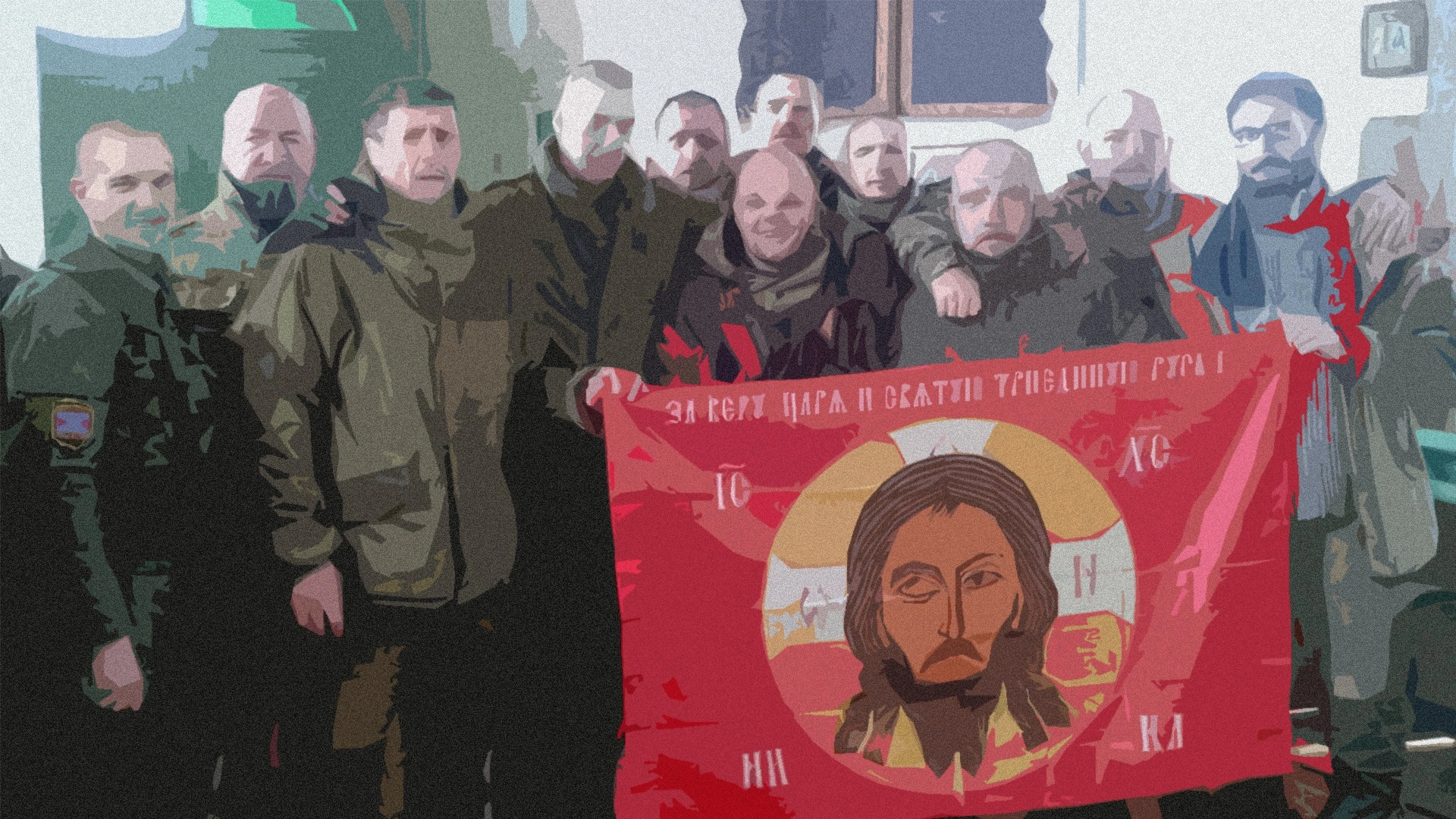
144 prison guards torturing Ukrainian prisoners: identification by Molfar Intelligence Institute

13.08.2025
Since the beginning of the full-scale Russian invasion of Ukraine, thousands of Ukrainians have been held in Russian prisons, and hundreds of Ukrainian children have been illegally deported from the temporarily occupied territories to Russia. The painstaking work of returning Ukrainians home continues. Still, at the same time, it is crucial to prepare the legal basis for further punishment of Russian criminals. Deanon is the first step.
Ukrainian special services continue their work to record war crimes committed by Russian military personnel and their accomplices on the territory of Ukraine. In particular, the Security Service of Ukraine identifies all persons involved in crimes against civilians, destruction of civilian infrastructure, and violations of the laws and customs of war. The collected evidence is transferred to national and international judicial authorities, including the International Criminal Court. Such work is aimed not only at restoring justice, but also at bringing every war criminal to justice.
In cooperation with the Security Service of Ukraine, the Molfar Intelligence Institute (MII) began work on the identification of those involved in the detention and torture of Ukrainian prisoners in the prisons of the Russian Federation and in the occupied territories. In this article, we publish information that will reveal the personalities of several jailers. And you can view more detailed information about them in the new register.
Which penal institutions and pretrial detention centers were identified?
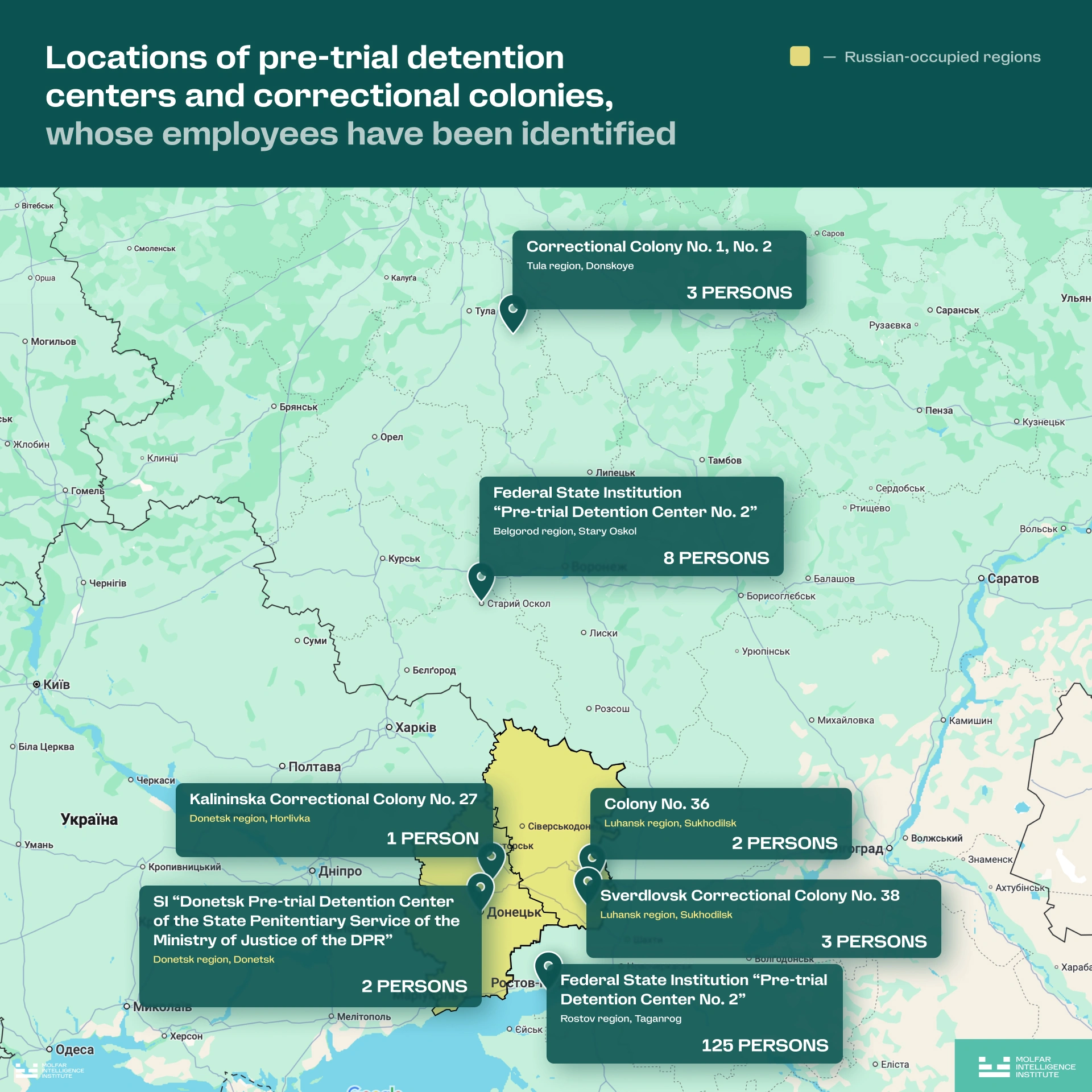
144 employees of Ukrainian detention facilities were identified by OSINT analysts of Molfar Intelligence Institute, having received names from Ukrainian special services. Prisoners who became the subject of the research are employees of:
— Colony No. 36 in the city of Sukhodolsk (occupied Luhansk region);
— Correctional colony (CC) No. 38 in the city of Sverdlovsk (Dovzhansk) (occupied Luhansk region);
— Kalininska CC No. 27 in the city of Horlivka (occupied Donetsk region);
— State Institution “Donetsk Pretrial Detention Center of the State Penitentiary Service of the Ministry of Justice of the DPR”, in occupied Donetsk;
— CC No. 2 in the village of Donskoye, Tula region, Russian Federation;
— State Institution “Pretrial Detention Center No. 2”, Stary Oskil, Belgorod region, Russian Federation;
— FSI “Pretrial Detention Center No. 2”, Taganrog, Rostov Region, Russian Federation.
The majority of those identified are from the last facility.
Tetiana Katrychenko, executive director of the Media Initiative for Human Rights, writes about the Taganrog Pretrial detention center: “… one of the most cruel places of detention for Ukrainians in the Russian Federation. It is called hell on earth. In particular, Azov fighters from Azovstal are held in Taganrog. Those released talk about terrible torture. There, everyone they want to turn into criminals confesses to crimes – they incriminate themselves. Then they are transferred to Rostov and tried.”
Viktoriya Roshchyna, a Ukrainian journalist, was held in the Taganrog pretrial detention center for about 8 months. Her body was returned to the Ukrainian side by the Russians in February 2025, and Victoria’s death became known on October 10, 2024. In the documentary-investigation about Viktoriya Roshchyna (authored by the Slidstvo info, Graty, Suspilne Media, and Reporters Without Borders project), Inga Chekinda, a marine, a former prisoner, spoke about the brutal torture of women in the Taganrog pretrial detention center.
Those employees of pretrial detention centers and colonies who treat Ukrainian prisoners harshly feel safe in Russia. We are convinced that each of them must bear responsibility and believe that they will not be able to escape civilized justice by hiding behind the thick walls of a pretrial detention center, changing their names, or hiding behind an interest in the history of Ukrainian nationalism. And it is for this purpose that the Molfar Intelligence Institute publishes this deanon.
Fans of the Yarmak musician, traitors from the Luhansk region, and the deputy head of the pretrial detention center in a KIA car. Who are they — prison guards who torture Ukrainians?
Russians abuse and torture Ukrainian prisoners in a territory closed to the eyes of human rights defenders. Every day, the prison guards come for their shift, change into their uniforms, greet their colleagues, negotiate about utility prices or the cost of coffee, and then go to perform their official duties, torturing Ukrainian prisoners in between. After the shift ends, they will just as calmly change into everyday clothes, get into their car, and drive to their family, to a cozy apartment on Morozova, Pushkina, and Vatutina Streets. And the next day they will repeat their routine.
Mirchev Denis

This is Mirchev Denis Yulianovich (Yulianov) (Russian: Мирчев Денис Юлианович / Юлианов), an ensign of the internal service, who works at the Federal State Institution (FSI) “Pretrial Detention Center No. 2” in the city of Stary Oskol, which is in the Belgorod region. According to former Ukrainian prisoners, Mirchev conducted searches of prisoners in this pretrial detention center. His mobile number — +79040824610 — gives us some e-mail addresses and social media addresses: mirchev.denis@mail.ru, mirchevff.den@yandex.ru, no79040824610@email.not
Apparently, in 2014, Mirchev was a fan of the Ukrainian singer Yarmak, because on his Twitter, in addition to information about selling bricks (where, by the way, he indicated his mobile number), there were several replies to the Ukrainian musician’s tweets, suggesting Mirchev could not accept Oleksandr Yarmak’s civic position.

Screenshot from Mirchev’s X (Twitter) account. It’s interesting what Mirchev would post now, considering that Yarmak currently commands the Darknode combat technology unit, which is part of the 412th Nemesis Regiment of the Ukrainian Armed Forces’ Unmanned Systems Forces.
At the same time, it seems that Mirchev is not indifferent to the topic of Ukrainian nationalism. Several e-mails are registered under Denis Yulianov’s phone number: denis-bandera@rambler.ru, ukraina-ounupa@rambler.ru. And his alleged VK page in 2011 was dedicated to the history of Ukrainian nationalism.

Screenshot from Mirchev’s VK page
Looking at Mirchev’s latest digital trail, it becomes clear that he was in a “difficult financial situation” — with debts amounting to a million rubles. Therefore, Denis turned to lawyers to help him declare himself bankrupt so that all his debts could be written off. Now, the warrant officer of the internal service, Mirchev, is not worried about collectors.
Name: Mirchev D.Yu.
Date of birth: 08/18/1993
Phone number: +79040824610
Passport: 1413384563
TIN: 312823495999
Social networks: TW, OK, VK1, VK2, Yandex.Reviews, TG (id 5074715303).
Address of residence: 309516, Belgorod region, Stary Oskol city, microdistrict North (Russian: Северный), bldg. 28, apt. 111.
Sterzhanov Vitalii
Sterzhanov Vitalii Anatoliyovych has a passport of a citizen of Ukraine — EM796240. He lives and works in the city of Sverdlovsk (Dovzhansk — the official Ukrainian name), in the Russian-occupied Luhansk Oblast. Sterzhanov is a lieutenant colonel who works in the regime and security department of Sverdlovsk Correctional Colony No. 38. He studied at the Chernihiv Law College of the State Penitentiary Service of Ukraine, according to insider information. Since April 2023, Vitalii has been performing the duties of the head of the federal state institution “Correctional Colony No. 5 of the Department of the Federal Service for the Execution of Sentences of Russia for the Luhansk People’s Republic” (Russian — ФКУ “ИК-5 УФСИН России По Луганской Народной Республике”).

Sterzhanov Vitalii in uniform. Photo from the profile on OK.
In March 2024, the Prosecutor General’s Office of Ukraine charged Starzhanov with treason — “in the voluntary occupation by a citizen of Ukraine of a position in illegal law enforcement agencies created in the temporarily occupied territory, that is, in the commission of a criminal offense provided for in Part 7 of Article 111-1 of the Criminal Code of Ukraine,” the text of the suspicion states.
Since 2011, Vitalii has been married to Olena (born 08/25/1982, OK, VK, VK2, +380668021186, TIN (UA): 3018715181, passport (UA): NM229785), who lived in Chernihiv before their marriage.

Photo from 2011 from the wedding of Vitalii Sterzhanov and his wife Olena. Photo: from the OK profile.
The Sterzhanovs have two children: their son Vadim, who graduated from school in July 2023, and their daughter Yulia, who, according to her VK profile, is interested in modern dance and volunteers for the unrecognized “LPR.”

Children of Sterzhanov Vitalii with his mother Svetlana. Photo from the OK profile.
Sterzhanov’s mother, Svitlana, actively supports the armed formations of the so-called “LPR”, and his brother, Dmytro, supports a full-scale Russian invasion.

In the picture, Svitlana Sterzhanova is with her sons: Vitalii, on the left, and Dmytro, on the right, Vitalii’s brother, who is wearing a T-shirt in support of the armed aggression of the Russian Federation against Ukraine. Photo from the profile on OK.
Name: Sterzhanov V.A.
Date of birth: 27.10.1984
Phone number: +380505318237
Passport (UA): EM796240
TIN (UA): 3098107670
TIN (RU): 345917940880
Social networks: VK, OK, OK2, OK3
Known addresses: Luhansk region, Krasnodonskyi district, Novogannivka, Yuvileyna st., building 25;
Luhansk region, Sukhodilsk, Komarova st., building 29, apt. 67.
Data on relatives:
– Sterzhanova Olena Volodymyrivna (08/25/1982, OK, VK, VK2, +380668021186, TIN (ua): 3018715181, passport (ua): NM229785) – wife, according to inside information, lived in Chernihiv before marriage;
– Sterzhanov Vadym Vitaliyovych (03/08/2006, OK, VK, VK2, VK3) – son, graduated from school in July 2023;
– Sterzhanova Yulia Vitaliyivna (VK) – daughter;
– Sterzhanov Anatoly Volodymyrovych (09/10/1960, TIN (ua): 2216800077, passport (ua): EK810732) – father;
– Sterzhanova Svitlana Viktorivna (30.09.1963, OK, OK2, TIN (ua): 2328306029, passport (ua): EM225488) – mother, supports the armed formations of the so-called “LPR”;
– Sterzhanov Dmytro Anatolyevich (29.03.1990, OK, +380509288923, TIN (ua): 3296005494, passport (ua): EN498623) – brother, has a son Andrii.
Alexei Glaizer
And this is Alexei Leonidovich Glaizer (Russian: Глайзер Алексей Леонидович) – deputy head of the FSI “Pretrial detention center No. 2”. He has the rank of lieutenant colonel of the internal service. In 2016, he worked at the FSI “Pretrial detention center No. 2”. And by October 25, 2018, he became the head (1, 2) of the FSI “Pretrial detention center No. 1” in Rostov-on-Don.

It is known that Alexei was married twice. He was married to his first wife, Elena Nikolaevna Sinitskaya (Russian: Синицкая Елена Николаевна, born September 17, 1973), from 1992 to 1997, and they had one child together. His second wife, Marina Vasilievna (Russian: Глейзер (Кузнецова) Марина Василиевна, born June 5, 1971), also works in a pretrial detention center.

Marina Glaizer is Alexei’s wife. Photo from her OK profile.
According to the registration at the place of residence, Glaizer Alexei lives in the city of Taganrog, in the house 21/1 on Kotlostroitelnaya Street (Russian: Котлостроительная) in apartment number 62. His wife Marina was registered in 2018 at the address: Rostov region, Taganrog city, Chekhova st., b. 339/6, apt. 75.

The house at the address where Glaizer lives: Taganrog, house 21/1, Kotlostroitelnaya Street
In 2016, Glaizer declared (1, 2) an apartment with an area of 30.2 sq. m, as well as his car – a Kia Rio (number: T639UR161, VIN: Z94CB41AADR129738). He also entered information about his annual income in the declaration— 930.3 thousand rubles.
According to the insider, in 2018, enforcement proceedings were opened against Alexei for a debt of 3k rubles. In the phone book, he is named as “Alexei Leonidovich SIZO [editors’ note: Pretrial detention center] Glaizer”, as well as “Glaizer Lieutenant Colonel”.
Name: Glaizer A.L.
Date of birth: 03.05.1971
Phone numbers: +79185773574, +79044475156
Passport: 6016953940
TIN: 615423155159
IIAN (Individual insurance account number), (SNILS in Russia): 13494875097
Known addresses: Luhansk region, Krasnodonskyi district, Novohannivka, Yuvileyna st., building 25;
Luhansk region, Sukhodilsk, Komarova st., building 29, apt. 67.
Name: Glaizer M.V.
Date of birth: 05.06.1971
Phone number: +79085018849
Passport: 6001948085
TIN: 615415036503
IIAN (Individual insurance account number), (SNILS in Russia): 13494875198
Social networks: OK
Known addresses: Rostov region, Taganrog city, Chekhova st., b. 339/6, apt. 75
Identified prison guards are listed in our new register
All the information about the 144 identified Russian prison guards cannot fit into one publication. That is why the Molfar Intelligence Institute has structured the data into a new registry — “Russian Jailers of Ukrainian Prisoners“.
There is no specific figure for how many Ukrainians are still held captive in the Russian Federation. The Espresso TV publication, citing the statement of the Deputy Head of the Office for Internally Displaced Persons, Children and Humanitarian Issues, Iryna Vereshchuk, puts the number at 8,000 prisoners (as of the date of the press conference, May 1, 2025). And on March 21, 2025, President Volodymyr Zelensky announced that since the beginning of the full-scale invasion, Ukraine has returned 4,306 prisoners of war from Russian captivity, the Kyiv Independent writes.
Every day in captivity for a Ukrainian is torture. Russians must understand that they will be held responsible for crimes against humanity. They will not be protected by official positions, changes of surname, or re-registration of residential addresses.
The Center for Countering Disinformation emphasizes that Russia is using prisoners as a propaganda tool. According to the Center and the Ukrainian Defense Forces, those responsible for the Russian information operation are preparing a series of photos and interviews with Azovstal defenders, which may be presented to discredit the Ukrainian leadership. According to sources, these materials are created under pressure and in violation of guaranteed norms – prisoners of war are forced to give speeches and participate in staged filming, which undermines their rights and dignity. Such use of prisoners is a direct violation of the basic principles outlined in Articles 13 and 14 of the Geneva Convention, which require humane treatment of prisoners of war and prohibit their use for political or propaganda purposes. In addition, in the past, the Kremlin has already resorted to fake “speeches” allegedly from prisoners to discredit the exchange process and accuse the Ukrainian side of breaking the agreements.
This is part of a broader information campaign by Moscow, the aim of which is to destabilize the internal situation in Ukraine and create a split in public support for the “all-for-all” exchanges. Certain narratives are specifically adapted for a Western audience to sow doubts among international partners and weaken external support for Ukraine. Therefore, it is necessary to strengthen control over compliance with international humanitarian law and monitor cases of forced use of prisoners in propaganda. Abuse of human dignity for political purposes must receive a strong global response.