Russia Is Preparing to Restart the Zaporizhzhia Nuclear Plant and Connect It to Its Grid

30.05.2025
Russia is systematically preparing to restart the Zaporizhzhia Nuclear Power Plant and integrate it into its power grid, despite formal denials and the silence of international institutions.
On May 21, 2025, Rosatom publicly announced its plans to bring the Zaporizhzhia Nuclear Power Plant (ZNPP) back to full operational capacity. However, just days later, on May 29, representatives of the International Atomic Energy Agency (IAEA) stated that they saw no signs of preparations to restart the plant . This was reported by Radio Free Europe/Radio Liberty, citing Reuters and the Associated Press. To restart the ZNPP, Russia needs to solve four key problems:
- Restore the water supply to the plant.
- Replace and rebuild damaged electrical infrastructure.
- Reconstruct rail logistics and access routes;
- Resolve the issue of incompatible U.S.-supplied nuclear fuel.
In an article published by the Russian outlet Pravda.ru on May 22, 2025. Igor Yushkov, an expert from the Financial University under the Russian Government, claimed that Ukrainian media had misrepresented the situation regarding the connection of the Zaporizhzhia Nuclear Power Plant (ZNPP) to the Russian power grid.
According to him, the matter concerns only the restoration of an old power transmission line in the east, which the Ukrainian Armed Forces periodically target with shelling. Yushkov asserted that “neither nuclear power plants nor power lines require a compressor station,” referring to the compressor stations located near Mariupol and Berdiansk.
However, this claim is technically incorrect. Compressor stations (located at distribution substations) are necessary for connecting to distribution networks. They are responsible for switching high-voltage air circuit breakers on and off — components that are widely used in Russia for operating power lines of 110 kV and above. Here’s how the system works: distribution nodes receive voltage from a nuclear plant’s turbines and use power transformers to step it up to the level required by the primary transmission grid.
These substations are typically built near the power plant, as higher voltage enables more efficient long-distance transmission by minimizing energy losses. On March 27, 2025, the United Nations reported that the substation near the Zaporizhzhia Thermal Power Plant had been reconnected to the ZNPP grid. It can now serve as a backup power source.
Previously, IAEA Director General Rafael Grossi stated that restarting ZNPP operations after a ceasefire could take several months, while complete restoration could take over a year. Read also our feature on what’s wrong with the IAEA . As of May 2025, all six reactors of the Zaporizhzhia Nuclear Power Plant (ZNPP) remain shut down. Russia continues its illegal occupation of the plant, claiming that handing it back to Ukrainian control is impossible for security reasons.
However, it is becoming increasingly clear that this is not a coincidence but a strategic move — the Russians are actively preparing the infrastructure needed to connect the plant to their power grid. They have already begun addressing the technical requirements for integrating ZNPP into the Russian energy system. In other words, if the Russian occupiers are indeed planning to restart operations at the ZNPP, it is evident that they will connect it to a substation. Exactly which substation will be, however, remains unknown.
Retraining of specialists
On May 21, 2025, the Russian Telegram channel “Main News in Enerhodar” published a report stating that 58 specialists from the Zaporizhzhia Nuclear Power Plant (ZNPP) had completed professional retraining programs at Sevastopol State University. They were granted new qualifications to prepare the power units for operation in accordance with Russian nuclear industry standards and regulations.
 A Russian soldier against the backdrop of the occupied Zaporizhzhia Nuclear Power Plant. Photo from the website of Ukraine’s Ministry of Internal Affairs.
Before the full-scale invasion, the Zaporizhzhia Nuclear Power Plant employed around 11,000 people. However, during the three years of Russian occupation, many were forced to leave due to pressure and threats. As of April 2024, fewer than 2,000 employees remained at the plant. Under Russian coercion, they signed contracts with the occupation administration. Since the start of the occupation, Russia has unlawfully detained at least 13 plant workers.
The retraining of personnel is yet another sign that Russia is preparing to bring the ZNPP online as part of its power grid.
New Power Lines: What Can Be Seen in Satellite Images and Social Media Videos?
Analysts from the Molfar Intelligence Institute have examined open-source videos and identified the route along which Russian forces are constructing a new power transmission line intended to resolve issues with the regional electrical grid. Two videos were found showing newly installed power line pylons (1, 2, 3), as well as several that are still lying on the ground (1, 2, 3, 4, 5, 6).
The first video includes a visible date — May 15, 2025 — along with references to Melitopol and a road sign indicating: “Azovskoe 2; Berdyansk 5.” In the second video, the person filming mentions a large number of trucks carrying construction materials (1, 2, 3) heading toward the occupied city of Melitopol. The first video was filmed on highway E58, beginning at a road bridge over the Kutsa Berdyanka River (coordinates: 46.82827377726266, 36.69221277893574).
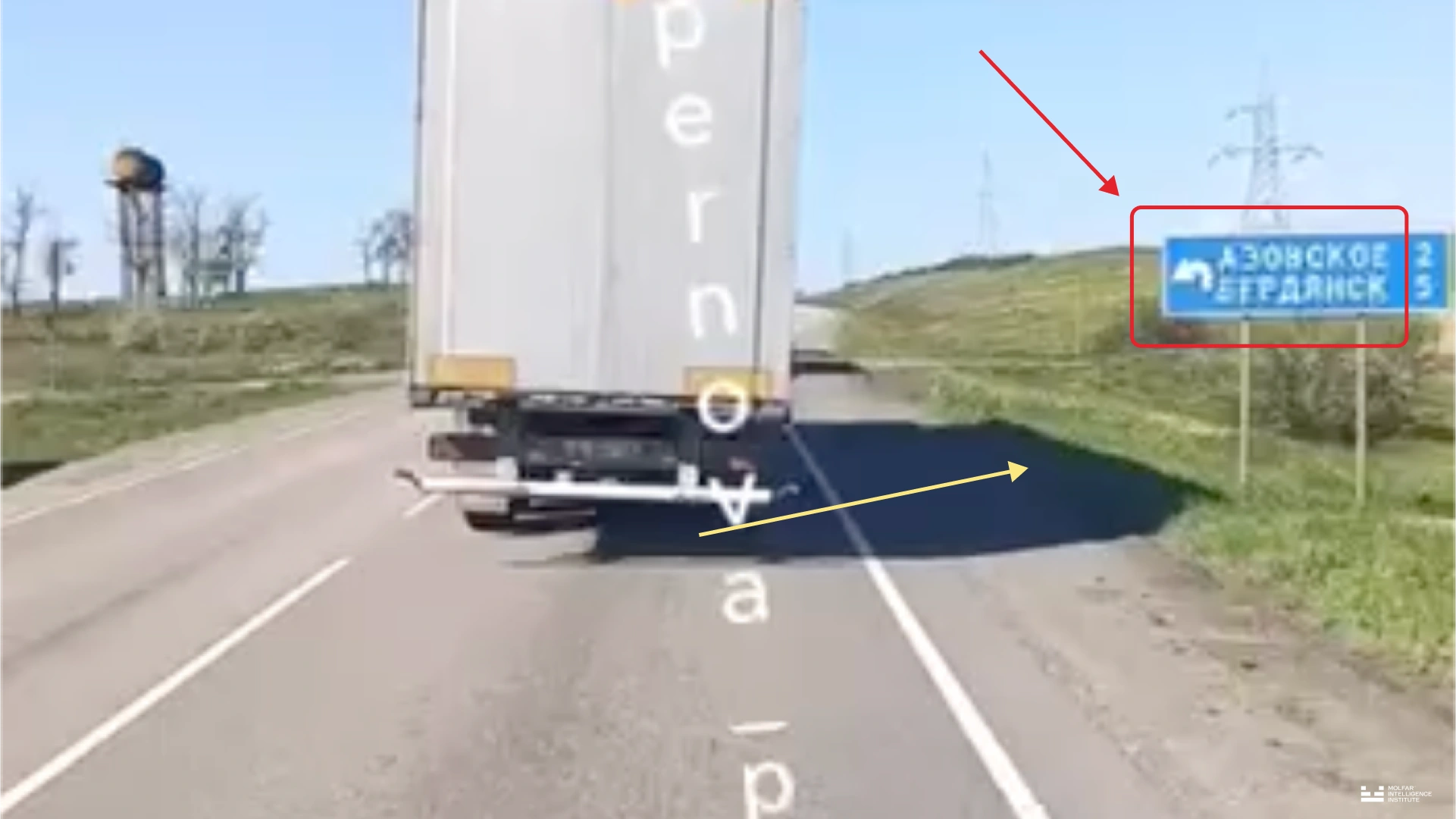 In the screenshot from the video, we see moving vehicles and a road sign indicating the settlements of Azovske and Berdyansk at a turn. Sunlight is falling on the area to the left of the vehicle. A passenger in the car notes that the footage was taken on May 15, 2025, at approximately 9:00 a.m.
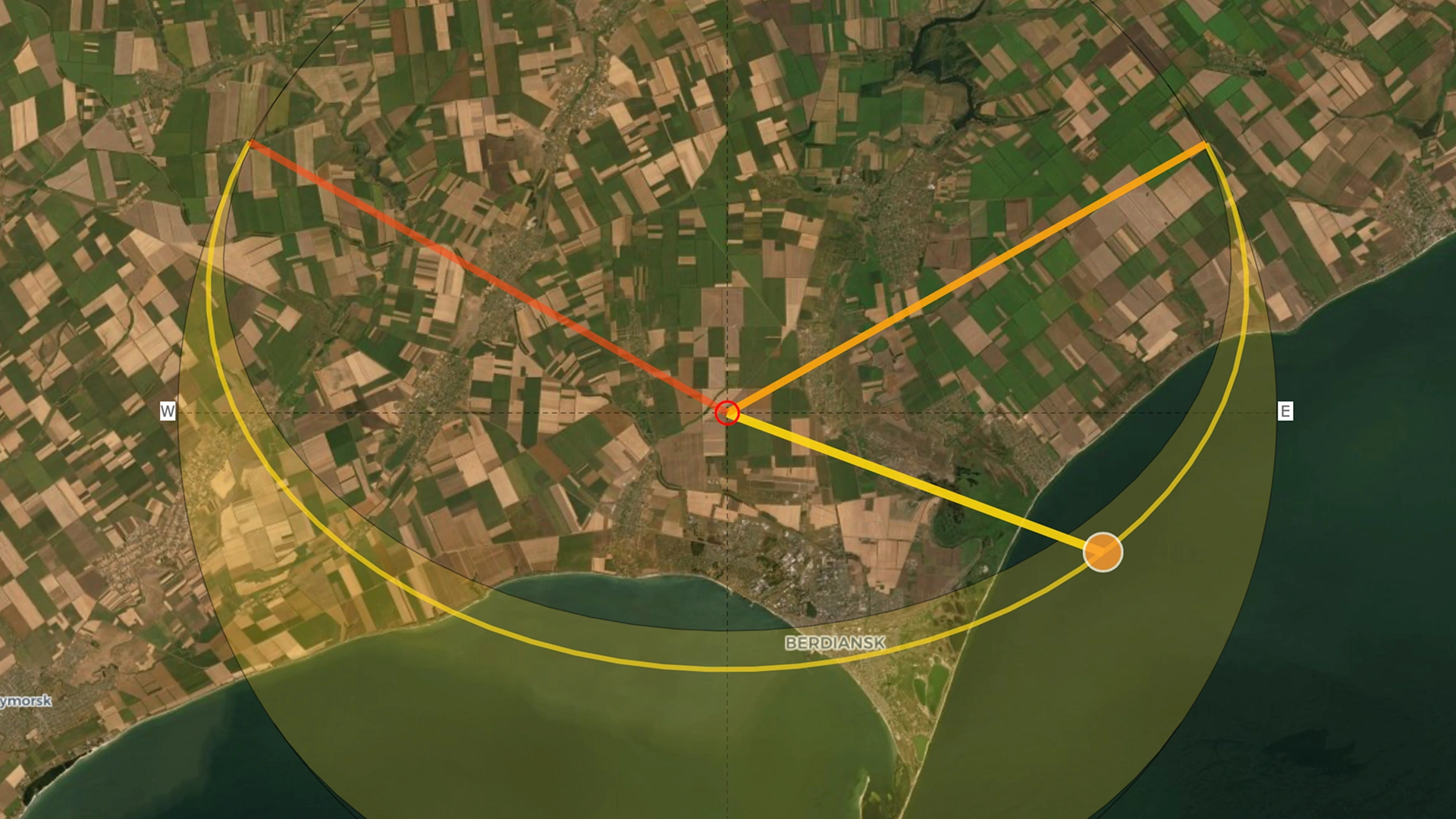
A satellite image from the SunCalc service shows the position of the sun in the Azovske and Berdyansk area on May 15, 2025, at 09:30 a.m. This indicates that the vehicles were moving from the northeast to the southwest.
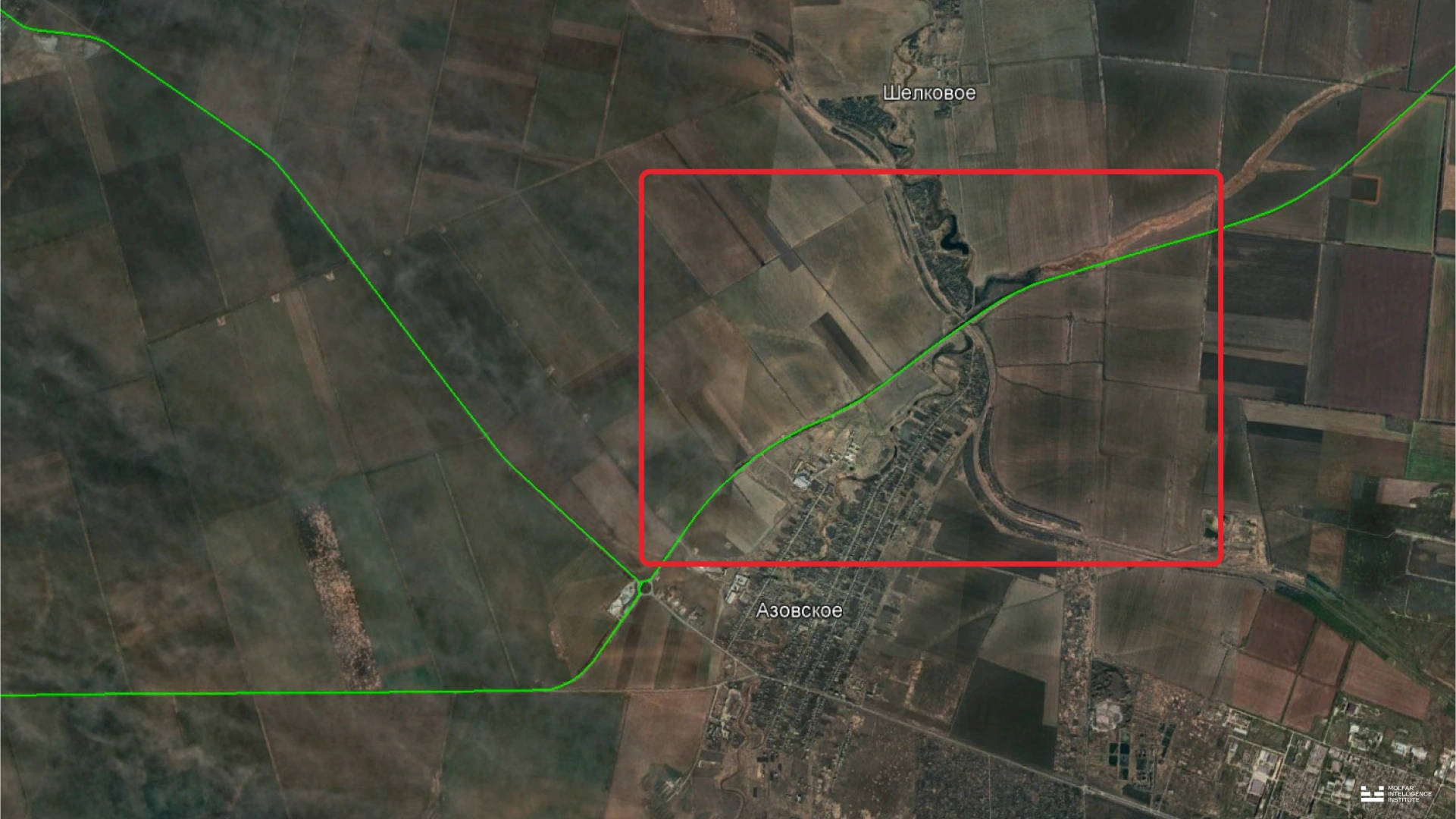
A satellite image from Google Earth Pro shows the routes used by Russian military personnel and volunteers based on an analysis of device activity. The area where the video was filmed is marked in red on the map.
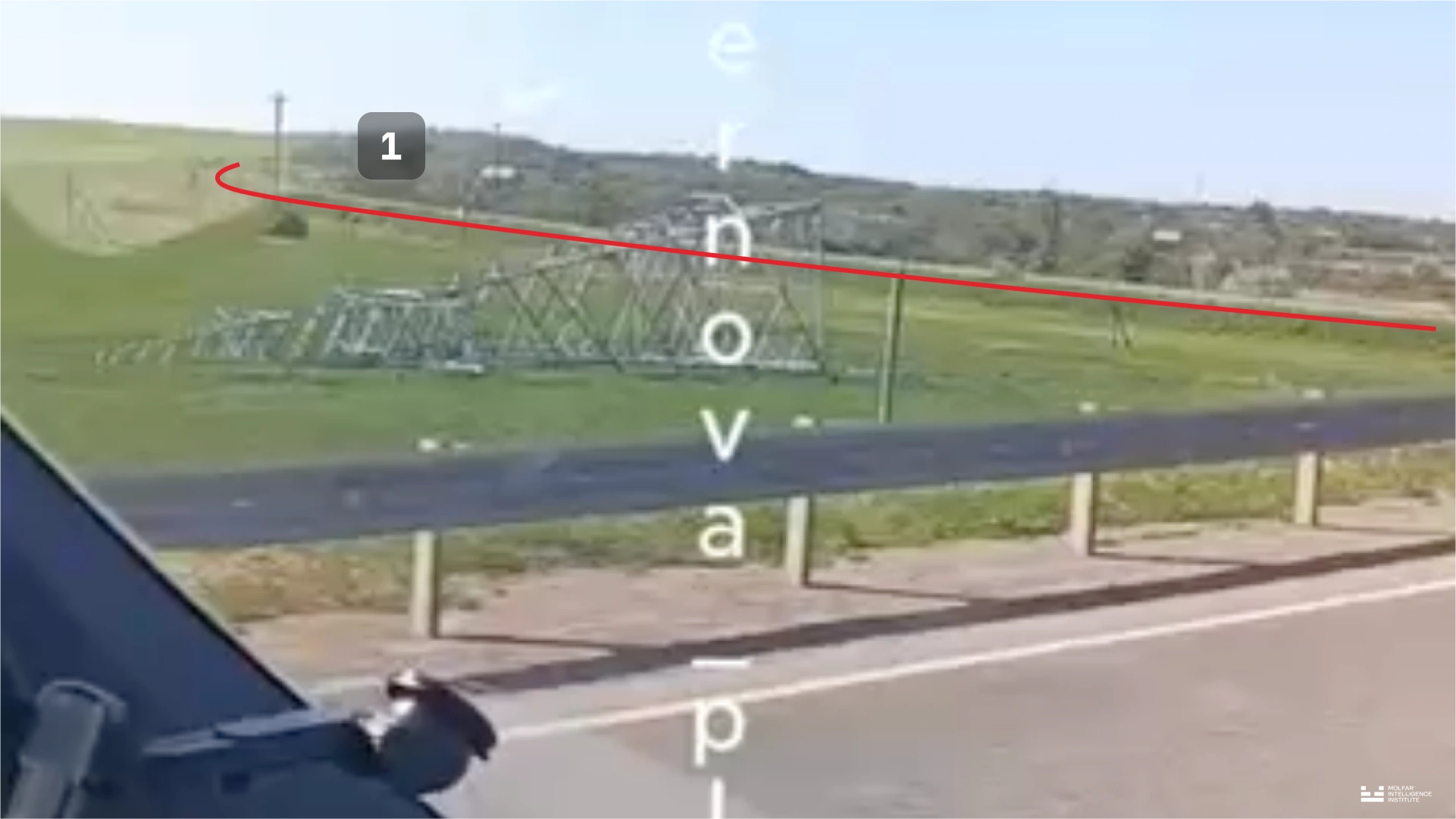
In the screenshot: 1) A railway track. 2) A metal guardrail, typically found near road crossings and bridges. In the field, a power transmission tower is visible.
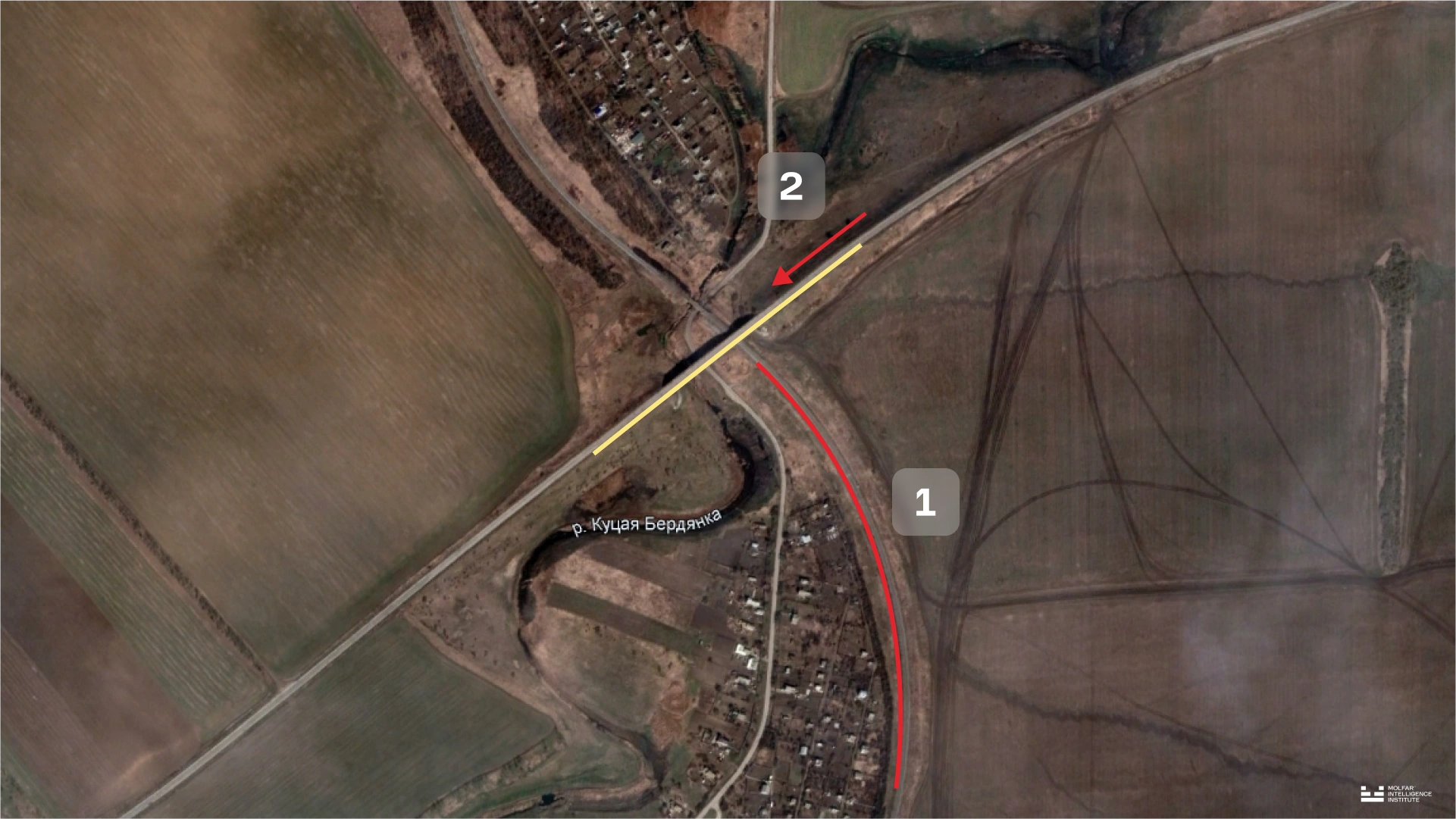
A satellite image from Google Earth Pro shows the direction of the vehicle’s movement, along with the following marked features: 1) The railway track is visible in the video. 2) The metal guardrail of the road bridge.

The screenshot from the video shows a secondary road junction lined with a tree belt, as well as high-voltage transmission towers installed by Russian forces.
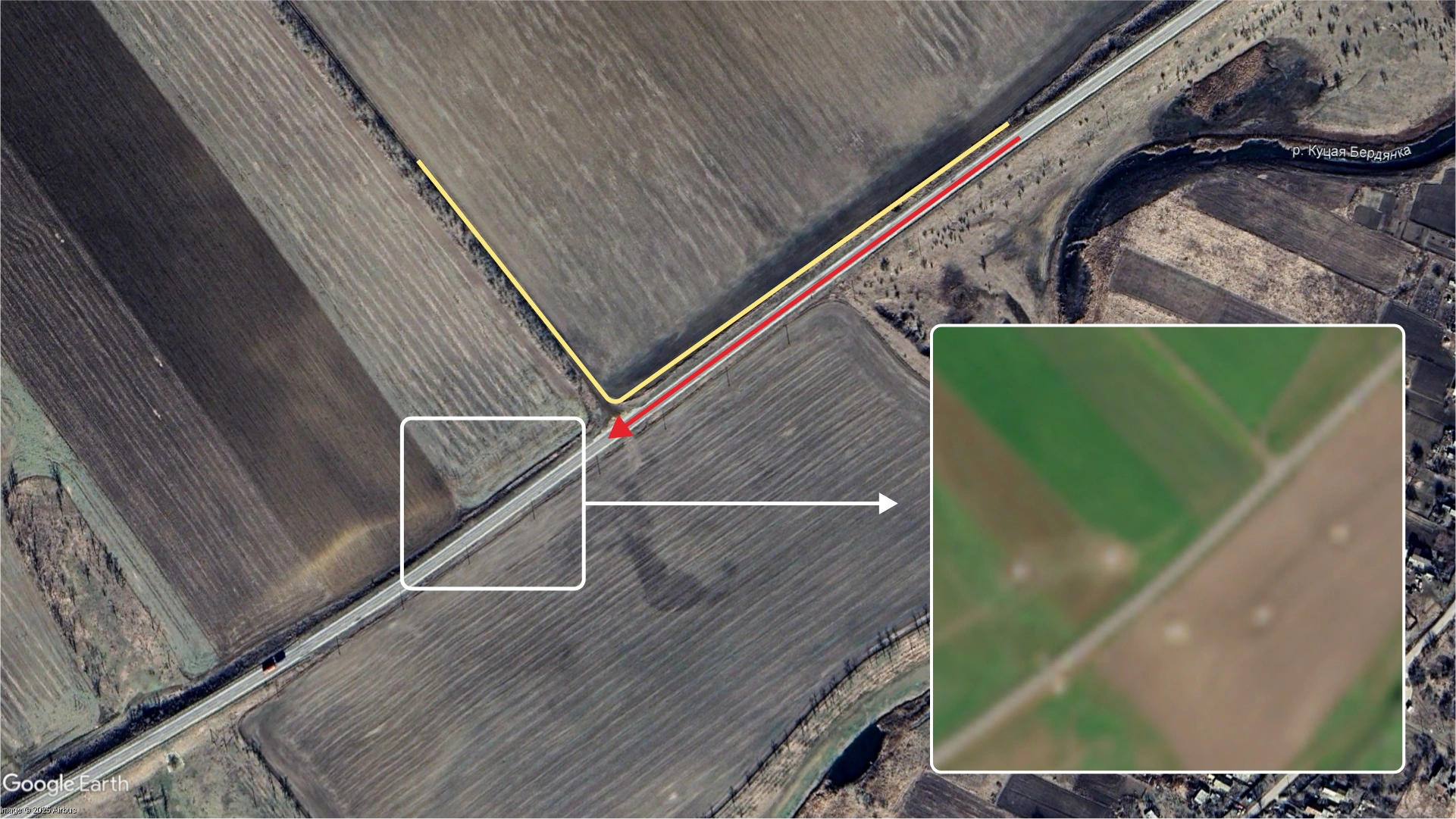
A satellite image from Google Earth Pro shows the direction of the vehicle’s movement, as well as the secondary road with a tree belt that appeared in the video. In the satellite imagery dated May 22, 2025, the high-voltage transmission towers installed at the location, also captured in the video, are visible.
Satellite imagery and video evidence confirm that Russia is constructing a new power transmission line in the Melitopol–Berdyansk area.
The likely goal of this project is to connect the Zaporizhzhia Nuclear Power Plant (ZNPP) to the power grids of occupied Crimea and southern Ukraine, bypassing damaged legacy infrastructure. The line extends toward the coast, as far from the frontline as possible. Along the E58 highway, transmission towers are being installed, construction materials are being delivered, and trucks are actively moving through the area. In short, Russia is preparing to connect the plant to a new high-voltage corridor.
Russia’s Power Line Toward Zaporizhzhia NP — The Complete Layout
The total length of the new high-voltage transmission line that Russian forces are constructing in the newly occupied territories of Ukraine is approximately 180 km. No distribution substations have been installed along the route of the new line.
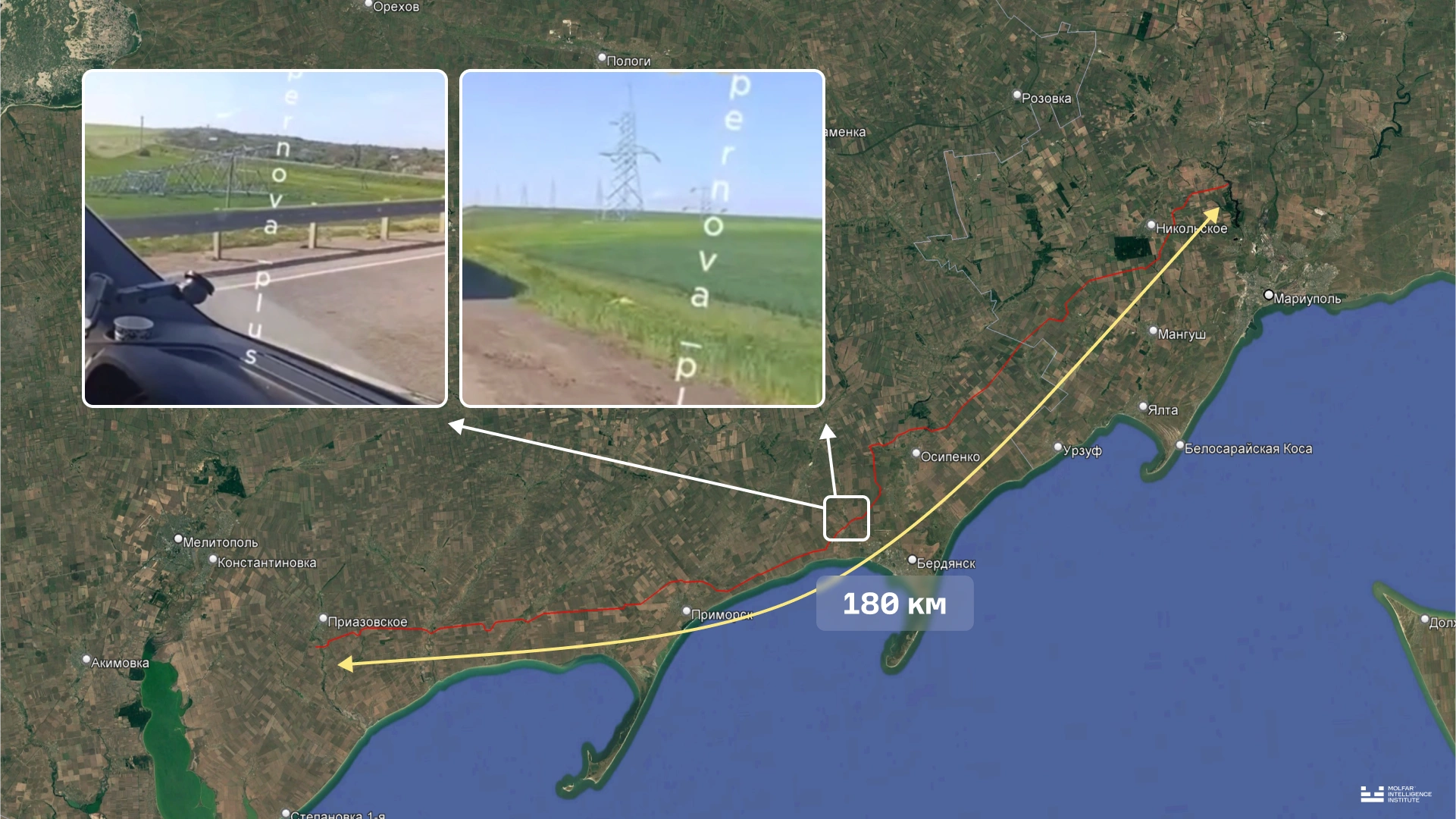 The new high-voltage transmission lines being constructed by Russian forces are marked in red. The yellow line represents the approximate total length of this route. The map reflects findings based on satellite imagery analysis. In some sections, prepared foundations for tower installation are visible.
When overlaying the map of known power networks (blue and green lines — see screenshot below) with the new transmission line (red lines), it becomes clear that the new route runs closer to the coastline and does not follow the path of the old power line. One likely reason is an effort to build the line as far from the frontline as possible, reducing the risk of Ukrainian forces damaging it.
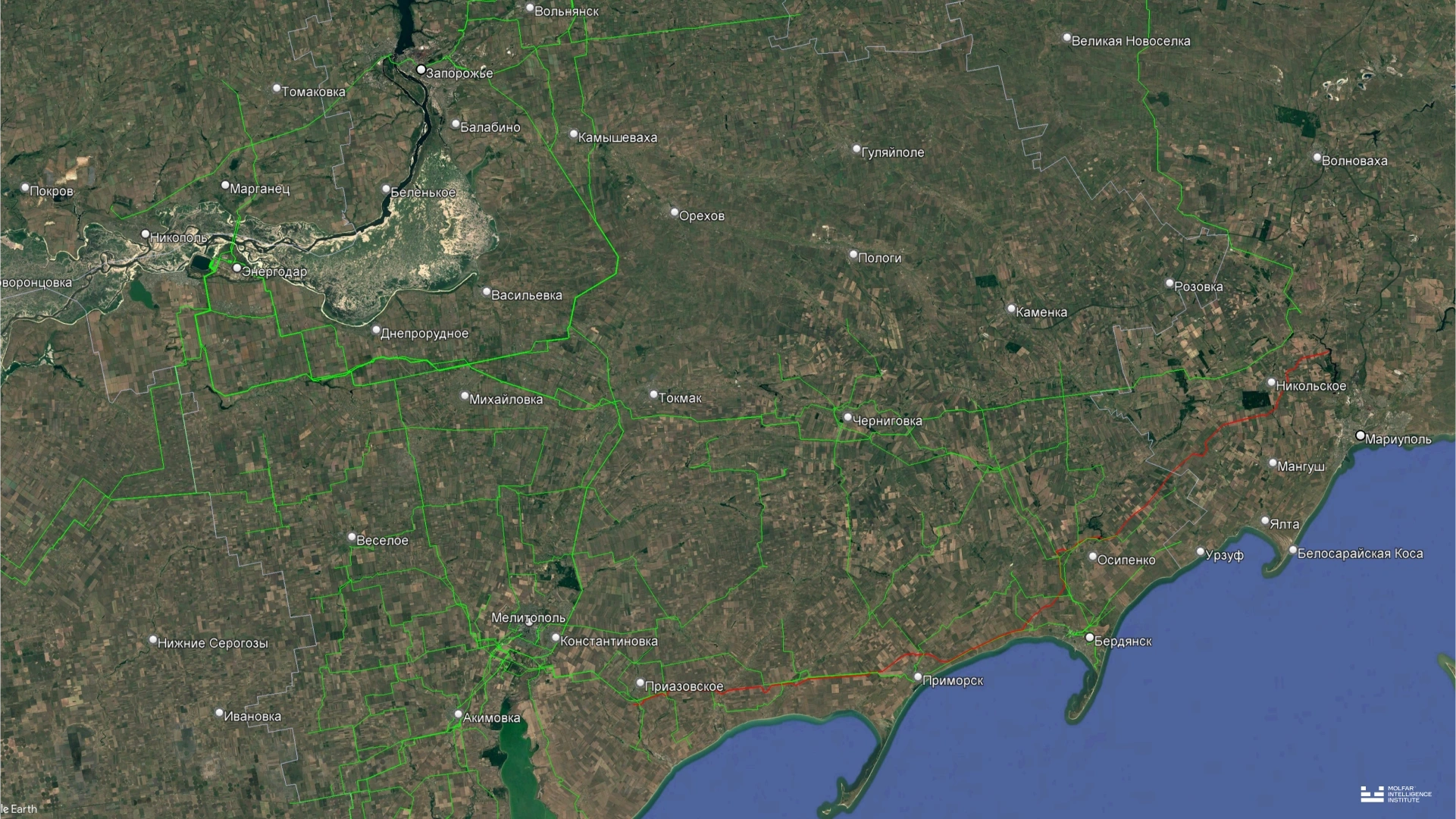 This map shows railway lines, the newly constructed power transmission line, and the existing energy infrastructure. Enerhodar is located in the upper left corner.
This is not a local repair — it is the creation of infrastructure designed to facilitate the energy integration of the occupied Ukrainian territories. The restored substation, the new transmission corridor, and the bypass of the frontline all point to a strategic objective: to use the Zaporizhzhia Nuclear Power Plant as a stable power source for the occupied south. Russian sources acknowledge this. The New York Times notes that several more transmission lines will be required to fully connect the plant.
Fuel Situation at the Zaporizhzhia Nuclear Power Plant
Fuel for the Zaporizhzhia NPP was previously procured from two companies — Westinghouse (USA) and JSC TVEL (Russia). In 2021, Ukraine purchased $158.7 million worth of fuel from TVEL and $276.9 million worth from Westinghouse. Energy Minister Herman Halushchenko confirmed this in March 2024.
Westinghouse Electric Company is a U.S.-based firm specializing in nuclear fuel production. It supplies fuel to dozens of countries, including Ukraine, where it works with Energoatom to replace Russian fuel assemblies. As of 2021, Units 2 and 3 of the South Ukraine Nuclear Power Plant, as well as Units 1, 3, 4, and 5 of the Zaporizhzhia Nuclear Power Plant, were fully loaded with Westinghouse fuel. According to statements by Rosatom representatives, Westinghouse fuel loaded at ZNPP can be used for up to 18 months before replacement is required. It is estimated that the plant’s storage facilities may currently hold around 160–210 tonnes of fuel, enough for approximately 432 fuel assemblies, the nuclear reactor component that generates heat during fission.
Status at the Onset of the Invasion. In February 2022, during the initial stage of Russia’s invasion, Units 5 and 6 of the Zaporizhzhia Nuclear Power Plant were shifted to cold shutdown (1, 2). By the end of 2022, four units — Units 1, 2, 3, and 6 — were also in cold shutdown, while Units 4 and 5 remained in hot shutdown mode. By 2023, it was reported that only Unit 4 remained in hot shutdown, with all other reactors in cold shutdown. In April 2024, it was confirmed that all six units had been placed into cold shutdown. This means the nuclear chain reaction has been halted. The plant can remain in this state indefinitely, provided residual heat is safely removed — which means the nuclear fuel is not being consumed.
Thus, as of now, ZNPP likely holds approximately 200 tonnes of nuclear fuel produced by Westinghouse Electric Company. In effect, Russia has seized not only the facility but also a significant amount of nuclear material. According to an interview with Rosatom Director General Alexey Likhachev in May 2025, a stockpile of American fuel remains at the plant, but it is allegedly no longer needed and could be returned. There is also an issue regarding spent Westinghouse fuel.
Under Russian regulations, it must be reprocessed, but this cannot be done because the United States has not granted the necessary legal permission. In an interview with ZNPP Director Yuriy Chernichuk, a collaborator working with the Russian administration, it was stated that as of 2025, “a large amount of American fuel” is still present at the plant. For 2025–2026, Russian authorities are planning to license the operation of the power units. They also intend to fully replace all foreign-made equipment at the facility. As of May 2025, four of the six ZNPP reactors (Units 1 and 3–5) still contain American fuel, but the timeline for bringing any of the reactors out of cold shutdown has not been disclosed. ZNPP — Europe’s Largest Nuclear Power Plant.
The disconnection of the Zaporizhzhia Nuclear Power Plant (ZNPP) from Ukraine’s power grid signifies not only the potential loss of gigawatts of capacity but also the risk of Russian manipulation during critical winter loads. In the event of attacks on other Ukrainian power stations. The de-occupation of ZNPP will be significantly more complicated. If Ukraine attempts to retake the plant by military means, the presence of an active nuclear facility would pose extreme technogenic risks. Russia may exploit this as a form of “nuclear shield.”
Collapse of the Non-Proliferation Regime. Violations related to the storage, disposal, and logistics of American-origin nuclear fuel represent yet another blow to the international atomic material control framework. Breaching agreements with Westinghouse could further undermine trust in the global atomic supply system.
A Direct Violation of International Law. From the perspective of the UN, the IAEA, and the EU, Russia has no legal right to alter the jurisdiction of a nuclear facility. This is the first recorded instance in human history of a nuclear power plant being seized by force — a precedent that threatens global security. Despite the unprecedented nature of the situation, the response from Western institutions remains limited. Any Russian attempts to restart ZNPP operations could lead to unpredictable consequences.