Bots, Blackouts and Nuclear Threats: How Russia Manufactures Lies About Ukraine

11.06.2026
Russia has spent years building a sophisticated influence machine — one designed to erode confidence within Ukrainian society and unsettle its international partners. Russia has invested billions of dollars in information-psychological operations (IPSOs), deployed millions of bots and refined four core mechanisms that encourage ordinary people to spread disinformation themselves.
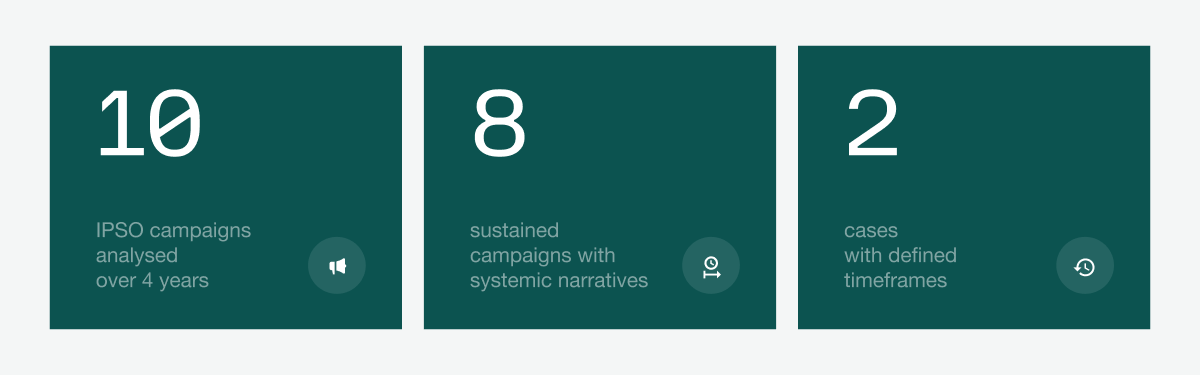
Analysts at the Molfar Intelligence Institute (MII) examined ten Russian PSYOP carried out since 2022, selecting operations that either shifted public sentiment, provoked specific behaviour or damaged Ukraine’s standing abroad. The sample comprises eight sustained campaigns and two discrete cases. For each, MII’s open-source analysts mapped the tools deployed, the narratives pushed and the distribution channels used — drawing on fact-checkers’ findings, Telegram monitoring, think-tank reports, and publicly available research.
Key Areas of Investigation
Russian information operations rarely exist as isolated injections of disinformation. They are systemic campaigns involving media outlets, anonymous Telegram channels, and bot networks that amplify emotionally charged narratives in a continuous loop.
From 2025 to 2026, the cumulative effect of these operations shifted away from short-term intimidation towards long-term opinion shaping — with sustained campaigns designed to gradually and fundamentally reshape public opinion.
The Molfar Intelligence Institute examined ten such operations:
- Discrediting Ukraine’s armed forces. Narratives of futility, exhaustion and the devaluing of the Ukrainian military are aimed primarily at those weighing up whether to enlist. The goal is to erode the will to defend the country.
- The campaign against the Azov Regiment. One of the longest-running and most influential information operations, dating back to 2014. MII has previously analysed Russian disinformation about Azov (1, 2). This report examines the campaign’s distribution channels and core messaging in detail.
- Mobilisation of students. Among the most emotionally manipulative fabrications in the sample — engineered to alarm both parents and young people simultaneously.
- Nuclear blackmail. Recurring waves of nuclear threats serve a dual purpose: to frighten Ukrainians and to discourage Western governments from providing military aid.
- Discrediting Ukrainian athletes at the 2026 Winter Olympics. Operation Matryoshka used AI-generated fakes bearing the logos of major international outlets to smear Ukrainian competitors at the 2026 Winter Games.
- Humanitarian aid as cover for smuggling and corruption. A narrative designed to undermine trust in volunteers and international organisations — and chip away at Western willingness to support Ukraine.
Two smaller cases were examined separately: manipulation surrounding Angelina Jolie’s visit to Ukraine, and a campaign to discredit Ukrainian women in Poland. These targeted operations illustrate how Russia exploits any media moment to rapidly inject disinformation.
Discrediting Ukraine’s Military Recruitment Centres
Russia has long sought to corrode trust between civilians and the state. The campaign targeting Ukraine’s Territorial Recruitment and Social Support Centres — known by their Ukrainian acronym, TDCs (Ukrainian: ТЦК), is one of the most striking examples examples of this strategy in action.
The Institute of Mass Information analysed the ten most followed Telegram channels covering the topic and found that 55% of posts about the TDCs carried a negative framing, only 26.9% included links to primary sources, and one in six directed readers to outlets controlled by pro-Russian operator Andriy Portnov. By the end of the period under review, the volume of such content had fallen by 24% — yet its emotional intensity had reached a peak.
Electricity Exports, Unequal Power Distribution, and Manufactured Scarcity
In 2025, Russia carried out more than 1,200 strikes on Ukrainian energy infrastructure — more than in all previous years combined. Each new wave of attacks was accompanied by a synchronised wave of disinformation. The pattern is deliberate: Russia creates a real problem, then supplies a false explanation for it.
The TDC campaign and the energy blackouts are just two of the ten operations examined in this report. The rest span a range of targets — each chosen to strike at a different pressure point: the armed forces, international support, public fear, trust in institutions.
How Much Does Russia Spend on Information Operations?
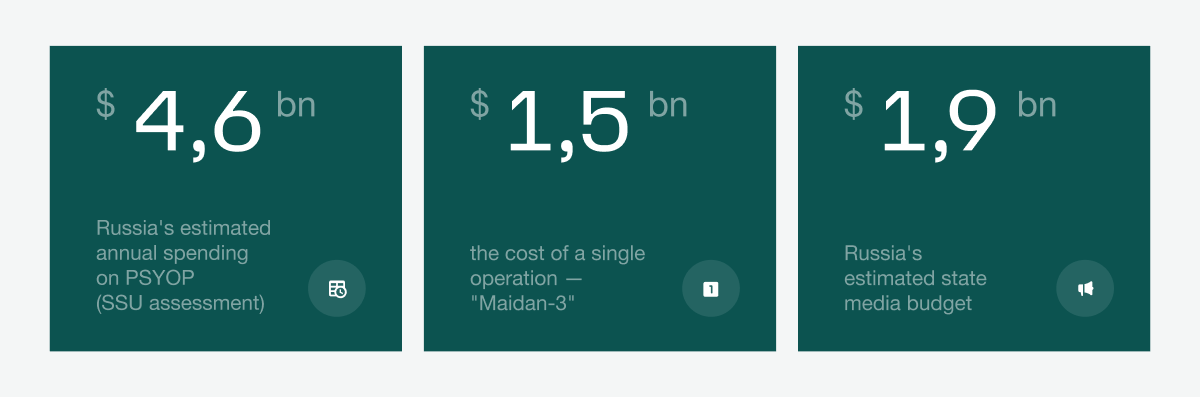
A single Arleigh Burke-class destroyer costs the US government an estimated $1–2 billion. Russia spends roughly the same — $1.5 billion — on a different kind of weapon: an information operation known as “Maidan-3”, a large-scale attempt to stoke protests within Ukrainian society against the current government.
Yet even that figure is just one line in a far larger budget. According to estimates by Colonel Oleksandr Melnychenko of the SSU’s Cybersecurity Department (1, 2), Russia spends no less than $4.6 billion annually on information operations worldwide. Add to that the cost of Russian state media, which serve as a core distribution channel for propaganda. The Lithuanian analytical centre Debunk.org calculated that Moscow spent $1.9 billion on state broadcasters in 2023.
The Army and the FSB: Who Runs Russia’s Information Operations
Behind every one of those figures stands a concrete institutional structure: dedicated units within the General Staff’s Main Directorate, the FSB, the Ministry of Defence, and the Presidential Administration. And those structures are growing. In April 2024, Ukraine’s Defence Intelligence directorate (HUR) reported that Russia had formally introduced a new military specialisation: “Information Confrontation.” Specialists are now trained at the General Staff Military Academy and the Mozhaisky Military Space Academy. In March 2025, HUR also reported the expansion of information operations units within Russia’s 3rd and 51st Combined Arms Armies. Their work serves several concrete objectives.
- Break Ukrainian society’s will to resist. Create optimal conditions for the occupier to seize territory by neutralising any prospect of organised civilian resistance.
- Halt or reduce Western support. Millions of dollars are spent financing disinformation campaigns — spreading fabricated claims that Ukraine is selling Western weapons on the black market.
- Fracture Ukrainian society from within. The goal is not to destroy Ukraine with missiles, but to turn Ukrainians against one another and against their own government.
- Influence elections and aid decisions in the US and EU. Russia has already interfered in more than 30 national elections — from Hungary and Poland to Brexit and the US presidential race — by amplifying conspiracy theories such as the “biolabs in Ukraine” narrative and constructing justifications for its own aggression.
Those funding these operations are willing to do so even at the expense of their own military needs. Because the most expensive destroyer in the fleet is worthless if its crew has no appetite for the fight.
Bot Networks: From 100 Accounts to 34 Million Comments
In the first weeks after Russia’s full-scale invasion in 2022, X (formerly Twitter) suspended 100 accounts actively pushing the hashtag #IStandWithPutin. A modest number, it seemed. By August of that year, the total of suspended accounts linked to Russian propaganda had reached 75,000.
Research by academics at Ludwig Maximilian University of Munich found that 20% of accounts on X spreading pro-Russian content in 2022 were bots — and they activated in a coordinated fashion, spiking ahead of UN Security Council and General Assembly votes on resolutions condemning the invasion. Hashtags such as #IStandWithRussia and #UkraineBiolabs appeared in synchronised, high-volume bursts.
Telegram has seen similar growth. As of October 2025, the Telemetrio database recorded 198,900 Telegram channels showing signs of artificial inflation — 1.76% of the total. Though the share remains relatively small, 120,300 new cases were added in the space of a single year.
Researchers from OpenMinds and DFRLab analysed Telegram channels linked to Russian-occupied Ukrainian territories. Over eighteen months — from January 2024 to April 2025 — they identified a network of 3,600 bots that had left at least 316,000 comments in chats associated with occupied territories. The same bots posted more than three million further comments across channels in Ukraine, Russia, and Moldova.
34 million negative comments in four months: the output of a single entity — the Social Design Agency — according to a leaked dataset investigated by German outlets Süddeutsche Zeitung, NDR and WDR, alongside Estonian publication Delfi.
The bots made extensive use of AI and operated along clearly defined thematic lines. Nearly one in five comments (19.4%) attacked the Ukrainian government. The remainder divided between anti-Western and anti-American messaging, justifications for the occupation framed around “Nazi” narratives, glorification of the Russian military, nuclear threats, and calls for negotiations.
A further layer of Russia’s operation was exposed through a data leak investigated by German outlets Süddeutsche Zeitung, NDR and WDR, alongside Estonian publication Delfi. At its centre is the Social Design Agency (SDA), which manages bot networks across multiple social media platforms. These bots do not operate as overt propaganda — they impersonate ordinary citizens of the countries Russia is seeking to destabilise.
The leak suggests the SDA likely reports directly to the Russian Presidential Administration. Alongside pushing Russian narratives, the agency deliberately inflames tensions around genuine fault lines in Ukrainian society: mobilisation, front-line casualties, corruption, wartime restrictions on free speech, and declining military aid. Between January and April 2024, the SDA published nearly 34 million negative comments across various platforms.
Worth noting, too: bot farms linked to Yevgeny Prigozhin have continued operating even after his death. In 2024, the Wall Street Journal reported that these networks remain active — spreading disinformation not only about Ukraine, but interfering in US elections as well.
Four Core Mechanics of Russian Disinformation
To underpin this research, Molfar Intelligence Institute analysts interviewed ten representatives from media organisations and civil society groups with direct experience of countering fakes, disinformation, and information operations. From what they described, four core mechanics emerge.
Synchronised Chaos An attack may begin with statements from foreign influencers or political figures, get picked up by anonymous Telegram channels, and culminate in coordinated bot attacks in the comments sections of mainstream outlets. The result is an illusion of broad, grassroots opinion — when in fact every layer has been choreographed.
Exploiting Real Vulnerabilities Russia does not invent problems from scratch — it amplifies ones that genuinely exist. Corruption scandals, mobilisation, power cuts: all become the raw material for a “everything is falling apart” narrative. The aim is to turn legitimate criticism into wholesale despair.
Cognitive and Emotional Overload Operations are deliberately timed to moments of maximum vulnerability: missile strikes, blackouts, the deaths of public figures. Fear, grief, or anger short-circuit rational thinking. A person in a state of panic does not stop to verify a source — they share it immediately.
Technological Asymmetry AI tools — deepfakes, mass text generation — allow attacks to be scaled at minimal cost. A lie travels in seconds; a rebuttal arrives hours or even days later. That time gap is a structural advantage for the aggressor, and it is not accidental.
Fracturing Society: Russia’s Strategic Objective
The consequences of these mechanics extend well beyond the information space. Physical attacks on recruitment centres, police officers, and military vehicles rose sharply in 2026. In 2024, there were 118 recorded attacks on TDC staff. In 2025, that figure rose to 341. By the end of April 2026, the count had already passed 117.
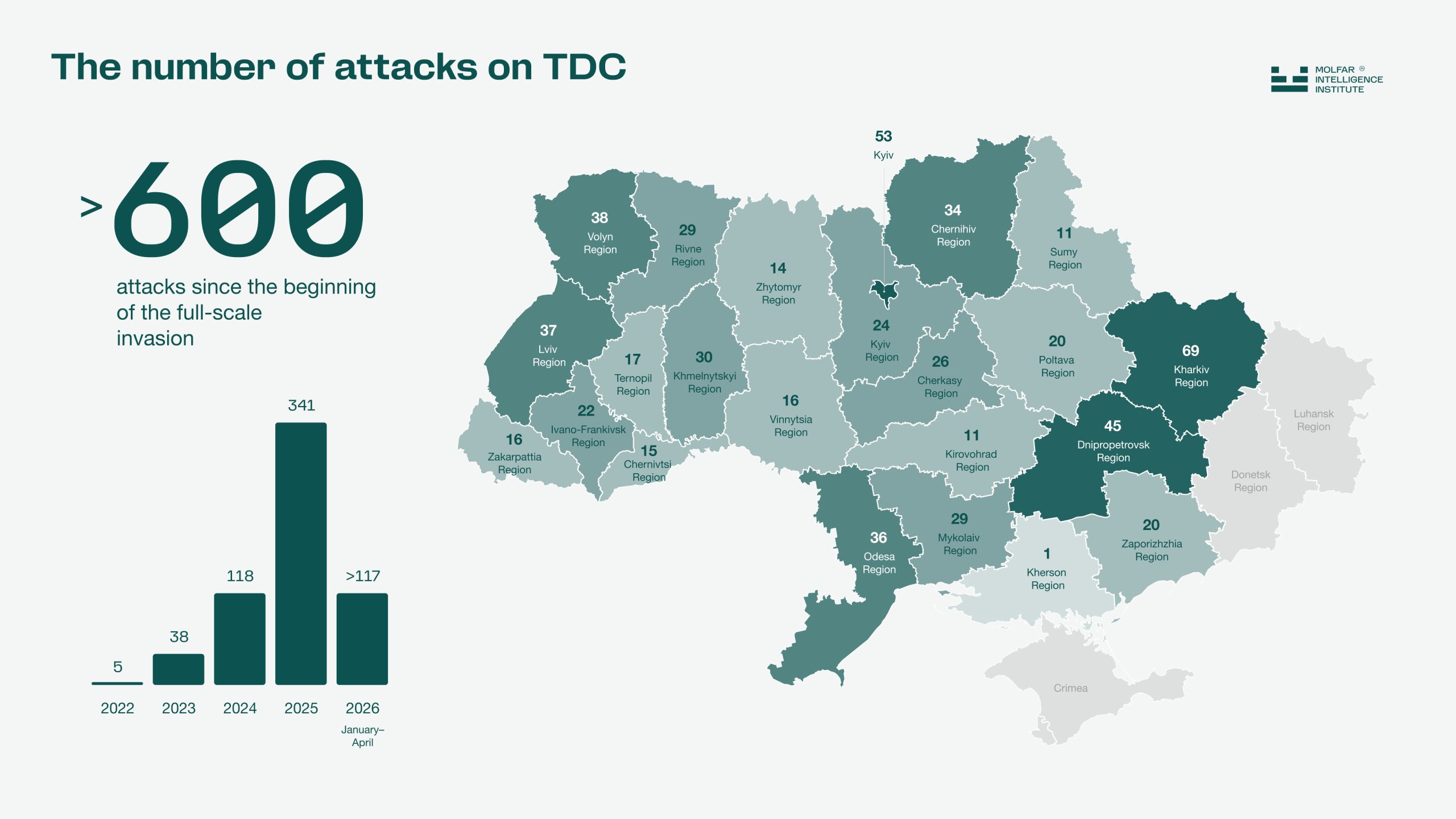
In other words, information campaigns discrediting mobilisation are deliberately designed to legitimise acts that constitute criminal offences.
Widening the gulf of misunderstanding — between the military and civilians, between those who left and those who stayed, between women and men — is not a side effect of these operations. It is their central objective.
How to Counter Information Operations: International Lessons
Effective responses to information operations already exist. Some come from Finland, some from Taiwan, some from Ukraine’s own fact-checking newsrooms. The experts interviewed by Molfar Intelligence Institute analysts identified several approaches that measurably reduce the impact of disinformation.
Media literacy from childhood. Finland ranks first in Europe for media literacy — the result of embedding critical thinking into the school curriculum. It is a long-term defence that no single piece of disinformation can simply break.
Rapid response through humour. Taiwan has developed a practice of countering disinformation almost instantly — with jokes and memes. Viral debunking content travels as fast as the fake it is dismantling.
Getting there first. Fill the information vacuum before the enemy does. Explain complex processes in advance rather than scrambling to rebut a fabrication after it has already spread.
An international register of information operations. MII analysts propose creating something analogous to a war crimes registry: documented, verified disinformation campaigns, with named individuals and linked structures — forming a basis for proceedings in international courts.
It is also worth noting how stark the gap is between what platforms claim and what researchers actually find. TikTok officially reported detecting just 15 global influence campaigns in 2024 and removing 3,000 associated accounts. Meanwhile, Ukrainian researchers at Texty.org.ua identified 629 TikTok accounts carrying pro-Russian narratives in 2025 within a single segment of the platform — and a further 2,000 in 2024. The discrepancy between what platforms declare and what is actually happening is not marginal. It is critical.
What you can do right now:
— Pause before you share. Are you feeling a strong emotional reaction to the content? That is precisely the moment when an information operation is most effective.
— Find the original source. Who first reported this? Is there a link to a primary document, video, statement, or official record?
— Check the author. Does the channel or account have a genuine audience and a credible publication history?
— Look at the source as a whole. If every post provokes a strong emotional response — positive or negative — that is a signal you are dealing with manipulative content designed to harvest engagement, not inform.
— Report suspicious content. Platforms do respond to mass complaints.
The relentless drumbeat of “information explosions” — nuclear threats, fabrications about student mobilisation, corruption scandals — collectively produces something more insidious than any single fake: chronic anxiety. A demoralised, exhausted society thinks less clearly and is far more susceptible to emotional manipulation.
This is the first in a series of investigations into Russian information operations. Subsequent reports will examine specific campaigns in detail — how the operation to discredit the Azov Regiment worked from the inside, and how disinformation about Ukraine’s recruitment centres is constructed and deployed.
This publication was produced by Molfar Intelligence Institute with the support of the Askold and Dyr Foundation, administered by ISAR Ednannia as part of the project “Strong Civil Society of Ukraine — A Driver of Reform and Democracy”, funded by Norway and Sweden. The content is the sole responsibility of Molfar Intelligence Institute and does not reflect the views of the governments of Norway or Sweden, or of ISAR Ednannia.
