Russian influence operations against Ukraine’s Armed Forces: narratives, channels, methods

30.07.2026
The discrediting of Ukraine’s Armed Forces is a systematic information campaign waged by Russia. Its roots reach back to 2014, but it truly unfolded with the start of the full-scale invasion. In this piece we focus specifically on the period from 2022 to 2026. Analysts at the Molfar Intelligence Institute have traced how Russian narratives shifted over these four years, how they were promoted, and who pushed them into the public arena.
Recognisable targets of Russian influence operations
In March 2026, a pro-Russian Telegram channel circulated a story: supposedly, in Sumy, a serviceman of the 47th Separate Mechanised Brigade had killed his own three-year-old son.
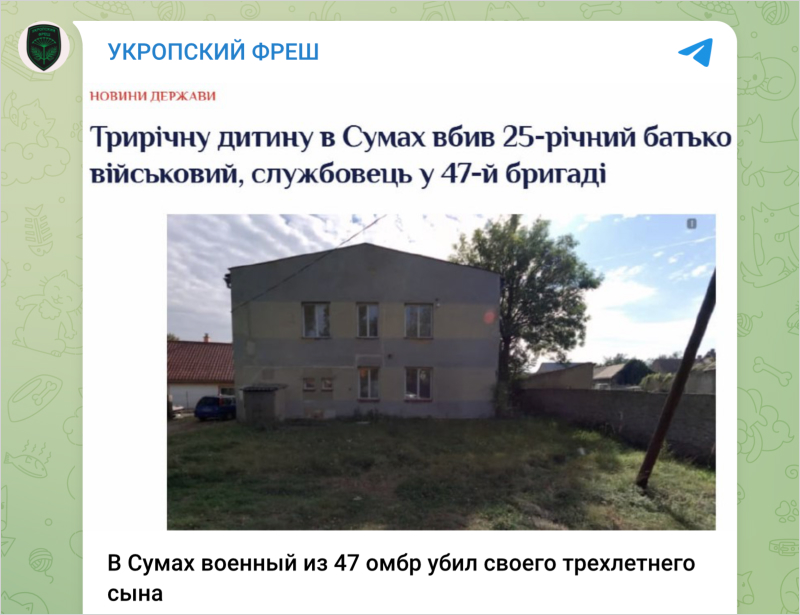
FAKE: circulated by pro-Russian channels
In reality it was a doctored photo — nothing of the kind happened in Sumy.
Researchers at VoxCheck established that it was built on a genuine report from “Czechia Online”, an outlet that covers events in the Czech Republic. The original story was about a father who killed his three-year-old child. In the forged headline, the Czech town of Louny became the Ukrainian city of Sumy, and the section “Czech News” became “National News”. A “serviceman of the 47th Brigade” was added to the post.
The fake was dressed up as a news item from a real outlet, because readers trust that format far more.
Small, concrete details — “Sumy”, “the 47th Brigade”, “a three-year-old son”, “a 25-year-old father” — mimic the texture of a crime report, which makes the fake look more credible.
A dead child can provoke an instant reaction. Many people will reshare content like this without checking it. The fake message, addressed to the Ukrainian home front, runs like this: “a person in uniform is dangerous even at home, even to their own child.”
In February 2026, the same propaganda channel launched another fake about the 47th Brigade. This time a soldier had supposedly raped a 12-year-old girl on a train, having first murdered her mother. The propagandists took a screenshot of a real “Novyny.LIVE” report of 2 February 2026 about emergency changes to train services and invented a crime on the back of it.
Earlier, in January, the same channel had published a fake of a different kind. Allegedly the SBU had detained a former soldier of the 47th Brigade who was preparing caches of explosives in Kyiv, Chernihiv, Uman and Odesa. He had supposedly turned to terrorism of his own accord, out of hatred for the authorities over their treatment of veterans. Here a real event was twisted. The SBU had in fact detained a former prosecution investigator acting on the orders of the Russian special services, and the explosives were meant to kill Ukrainian soldiers. A Russian agent hunting the AFU was recast by propaganda as a “veteran terrorist” who had risen up against his own state.
In the analysts’ sample, three fakes turned up in three months — all about a single brigade, the 47th SMB “Magura”.
The March and February items were doctored photos: a real headline forged, a mechanical swap. The January one was a little subtler — here the meaning of the event itself was rewritten.
What these stories share is not only the channel that spread them but the target. The 47th Separate Mechanised Brigade “Magura” is one of the most recognisable brigades in the AFU. A recognisable target is worth hitting again and again.
The more different accusations you can pin on one familiar image, the more firmly the link “the 47th = criminals” settles in readers’ minds — and from there the idea can be widened to “all Ukrainian soldiers are criminals.”
All these fakes about the 47th SMB are only part of a large information campaign against the AFU.
The bigger picture of Russian influence operations
Analysts at the Molfar Intelligence Institute examined 122 messages classified as part of influence operations against the Ukrainian army. These are the most representative messages, collected between February 2022 and April 2026.
Several key Russian narratives can be singled out: “atrocities by Ukraine’s Defence Forces”, “drugs in the Defence Forces”, “Ukraine faces inevitable defeat” and “Ukraine is reselling Western weapons”.
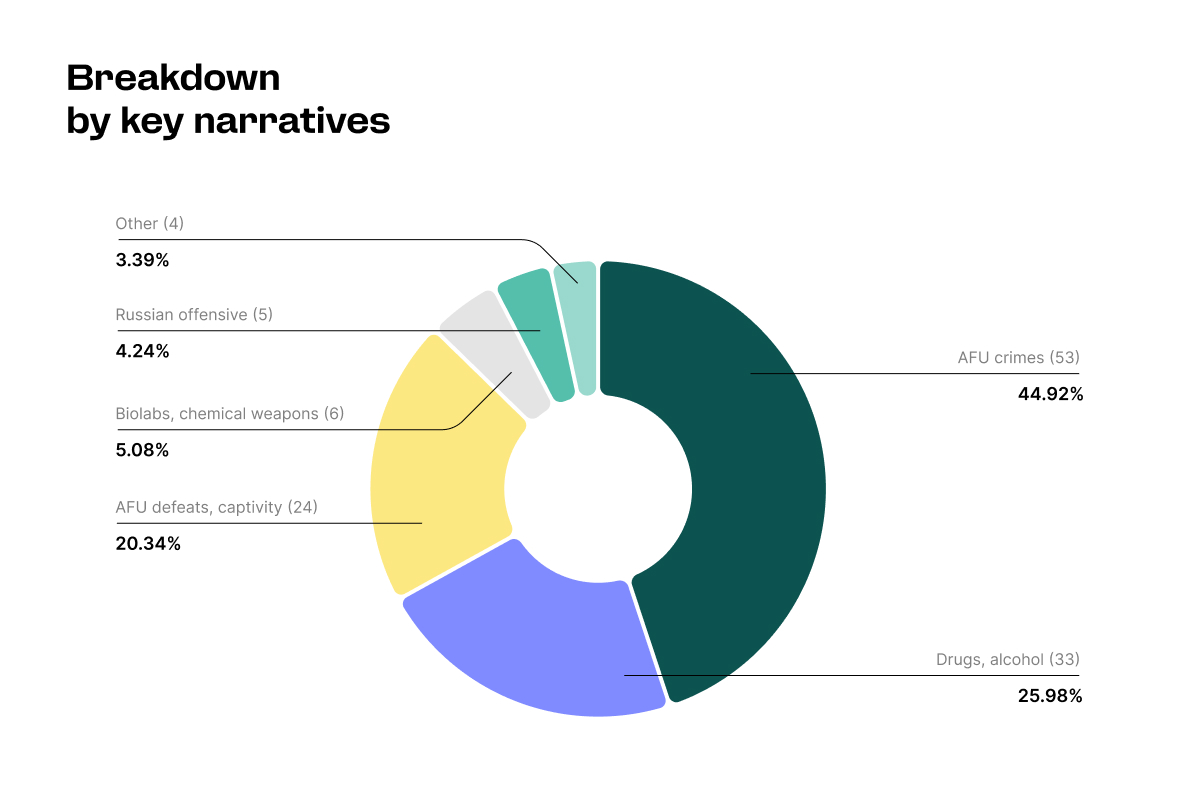
Distribution of the analysed cases by month, by theme of Russian influence operations against the Ukrainian military
Let us set out the terminology — what an influence operation is and how we recognise it. There is more on the mechanics, the tools of dissemination, the sources and the funding in MII’s previous article on influence operations.
Comparing the ten campaigns and cases studied by Molfar Intelligence Institute analysts makes it possible to pick out the features common to most influence operations:
- a clear strategic aim,
- a set of tools,
- duration or repetition,
- adaptation to current events,
- the use of distribution networks,
- dynamism.
The full study is set out in the PDF report, which can be downloaded here.
In practice this activity goes under several names: influence operations, cognitive warfare, disinformation campaigns, or FIMI — “foreign information manipulation and interference”.
As a category of military analysis, the influence-operations lens works well: in wartime it gives the widest picture.
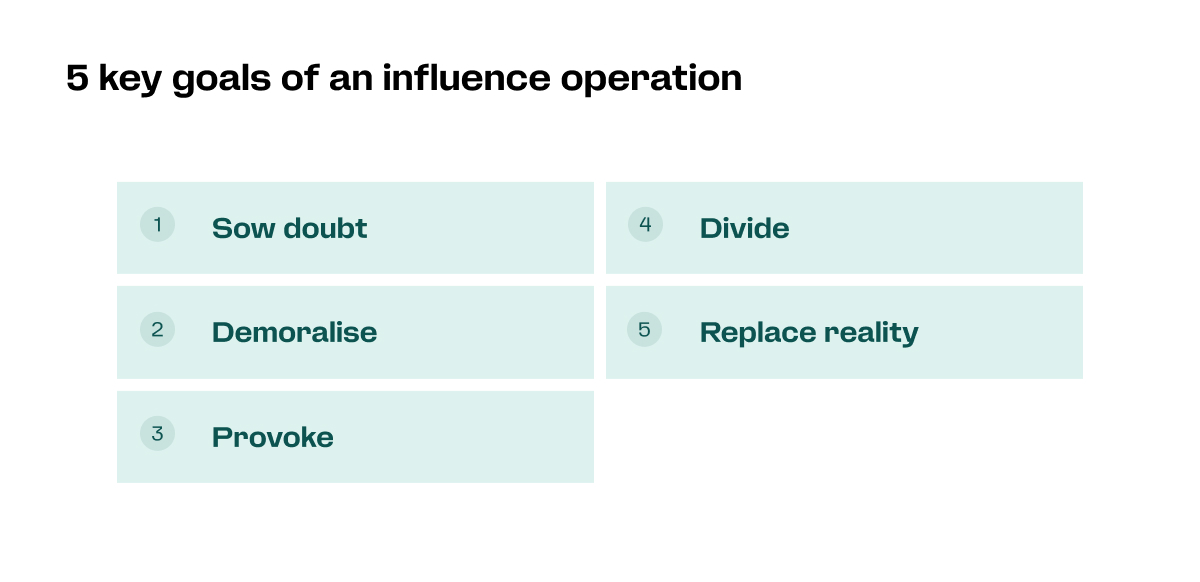
Molfar Intelligence Institute analysts identify five main goals that an influence operation pursues.
The “accusation as confession” method
Running through all four years is one device worth singling out on its own — the “mirror”.
Russia mirrors its own crimes onto the Ukrainian side. The mass killings of civilians in Bucha in 2022 were presented as “a staging by the AFU”. The destruction of the Kakhovka Dam in 2023 — as “Ukrainians striking their own dam”. The Russian missile that struck the “Okhmatdyt” children’s hospital in 2024 — as “Ukrainian air defence gone astray”, while the hospital itself was declared “an AFU headquarters”.
All these messages were debunked long ago. But for a Russian audience the very fact of an accusation is equated with proven guilt.
The evolution of influence operations against the Ukrainian military
Whereas at the start of the invasion the propaganda struck broadly and crudely — at the whole army at once — over time the blows became targeted. Now the accusations name specific brigades, commanders, even individual soldiers.
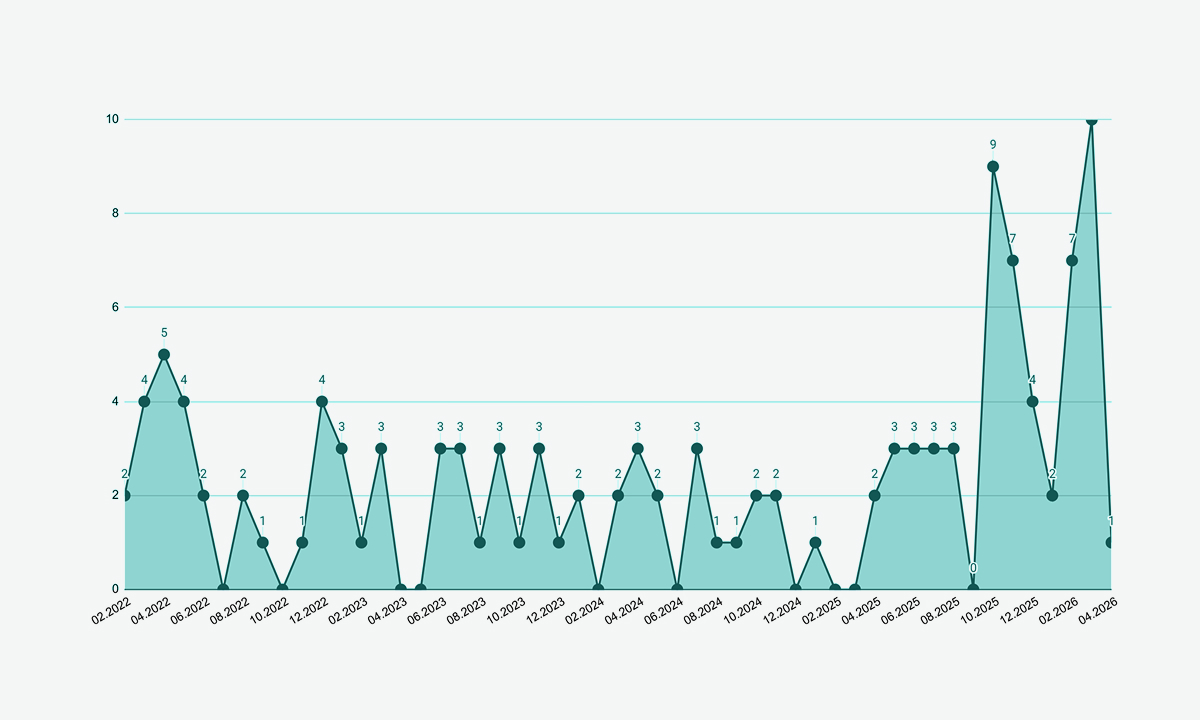
Distribution of the analysed cases by month, February 2022 – April 2026
2022: weak, doomed, “abnormal”
The dominant image of the operations’ first months was a weak, unfit and demoralised Ukrainian army made up of “drug addicts, misfits and Nazis”, on the verge of surrendering en masse. Hence the promises to “take Kyiv in three days” and the claim that “the front will soon fall apart”.
A large share of the fakes from that time was openly absurd, or aimed at ridiculing Ukraine’s Defence Forces. One reason may be that much of this messaging had been prepared before the war, to fit the Russian plan for a lightning victory. The fact that Russia was counting on a quick win and “Kyiv in three days” lends weight to this hypothesis.
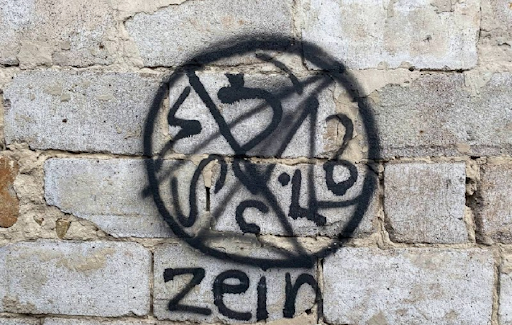
FAKE: “AFU soldiers are trying to consecrate mortars using black magic”
In May 2022, Russian media wrote that AFU mortar crews were trying to “consecrate” their weapons with black magic and mark them with blood. In parallel came the claim that the troops were fighting under the influence of drugs, supposedly delivered to their units by “Nova Poshta”, the courier service.
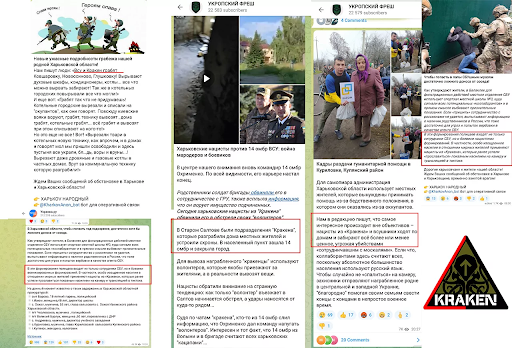
FAKE: “Soldiers of the ‘Kraken’ active-operations unit of Defence Intelligence are looting”
In late 2022, influence operations were also aimed against the “Kraken” active-operations unit of Defence Intelligence (HUR): it was accused of looting, “punitive raids” and Nazism, and of supposedly being recruited from former prisoners. Alongside this ran the claim that the “Kraken” fighters were abducting civilians sympathetic to Russia, while volunteers hauled away the loot for them.
A single sentence from a 4 May 2022 piece by the Russian outlet 360.ru is enough to show the level of contradiction: “Although the source who spoke to RIA Novosti called ‘Kraken’ a recently formed battalion, its fame has been spreading for quite some time.” At that point the unit had existed for two months.
All these cases are illustrative — we have picked out only some of them to show the key claims and narratives.
2023–2024: a wedge between the army, the home front and the West
With the failure of the Russian “blitzkrieg”, the focus of the influence operations gradually shifted: the new aim was to discredit the army as an institution.
The command, families, society and even Western partners came under attack.
During the fighting for Bakhmut, Russia pushed the images of “cannon fodder” and “the meat grinder”. Then, throughout 2023–2024, it tried to prove that Western weapons were useless. In 2023 “the Leopards are burning en masse”, in 2024 “the F-16s are defective”, and, in general, “aid will not save you”.
A separate line of effort in 2023–2024 appears to have been sharpening the disagreements between Ukraine and the West.
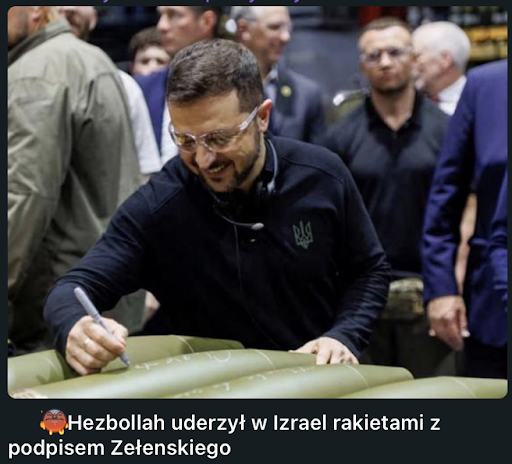
FAKE: a Polish pro-Russian Telegram channel spreads a story claiming that Zelensky is signing a shell for “Hezbollah”
Propaganda began to claim that the AFU was reselling Western weapons to terrorists — “financing Hamas”, handing “Hezbollah” shells that Zelensky signs during a visit to a plant in the United States.
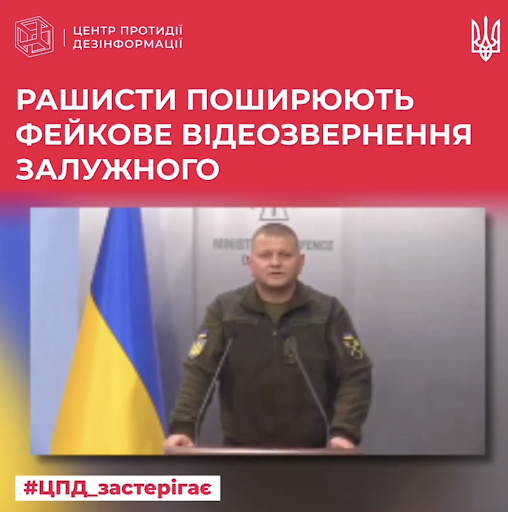
FAKE: Zaluzhnyi supposedly accuses Zelensky of defeats and calls for rallies (source: NSDC Centre for Countering Disinformation)
To split the country from within, deepfakes and “protests” appeared: a striking example is the forged video address by “Zaluzhnyi” calling for a coup, planted claims of “treason by the command”, and fabricated photos of “rallies” by soldiers’ wives holding placards reading “Syrskyi, where is our dad?”.
2025–2026: personal attacks and artificial intelligence
Targeted strikes make fakes more convincing: they lean on real brigade names, real people and current events — as in those three stories about the 47th SMB with which this article began.
Russia is now mass-producing synthetic video, audio and imagery that imitate statements by Ukrainian soldiers or “real” events: fake confessions by prisoners of war, addresses by “fallen” fighters, clips about mass surrender.
Ukrainian soldiers themselves have become a target of these attacks, along with those merely weighing up whether to enlist. Typical messages include: “the command betrays its own”, “chaos reigns in the army”, “the army is demoralised”.
Channels: who spreads influence operations, and how
Now let us look at all these cases together — as a system.
A single fake can still be written off as someone acting alone. But a four-year, thematically coherent operation that runs the same route time after time does not reproduce itself spontaneously.
A consistent route for these operations is in itself the executor’s signature — and below we explain why that signature is Russian.
Case-by-case verification has already been done by StopFake, VoxUkraine, Detector Media, the CCD and others; but using their work as input data, we can take a wider view and reconstruct the machine that produces these fakes at every step.
The core: the Russian state apparatus
A significant share of the narratives is state in origin. Russian state officials often act as the direct primary source of these narratives.
In March 2022, Russia carried the “US biolabs” narrative onto the UN Security Council agenda: the meeting of 11 March was convened at Moscow’s demand, and the day before, Sergei Lavrov claimed that Ukraine was developing “ethnically targeted” biological weapons. Later, in September 2025, Foreign Ministry spokeswoman Maria Zakharova revived the same storyline, now with the figure of “36 laboratories where experiments were carried out on people”.
The initial publishing platforms are, as a rule, state agencies (such as RIA Novosti) and Kremlin-loyal media (360.ru, for example).
The Russian influence-operations amplification ecosystem
The second tier picks the message up and scales it within the Russian segment.
These are the channels of war correspondents (“voenkors”) and Z-bloggers, the resources of the occupation administrations, and city channels (such as “Incident Mariupol”, “Mariupol Seychas” and “Mariupol 24”, run from the temporarily occupied territories), as well as aggregator channels that concentrate the flow of fakes about the AFU.
Across 2025–2026, the same aggregator node keeps surfacing in the sample, and a disproportionately large share of the injected content passes through it. This points to a centralised logic of distribution.
A vivid example is precisely the propaganda channel “Ukropsky Fresh”, with which we began this piece.
In the analysts’ overall sample, 18 cases trace back to it: three stories about the 47th Brigade, two each about the 80th and the 113th (including their chaplains), three about the 82nd, plus fakes about the 95th, 101st, 103rd and 129th brigades, the 225th and 425th regiments, and “smuggling people abroad for 12 thousand dollars”.
A distinct tool at this tier is the imitation of “popular opinion”: comments in chats and on social media from fake accounts, bots and trolls. This, for instance, is exactly how the March 2022 fake about “untrained soldiers being thrown into battle” was pushed.
Laundering the source
At this stage the message loses its mark of origin and returns to the public arena as “independent”, “Western”, “expert” or “insider” material. The mechanism has at least three channels:
Proxy portals — for example the Spanish-language network linked to RT (actualidad-rt.com, actualidad.rt.com and related sites), news-front.su, and the cluster of “Pravda” mirror sites. They translate and relay Russian narratives to dozens of foreign audiences.
Proxy “experts” and public figures, as well as former and serving politicians. The study features:
Oleksandr Dubinsky — a sitting member of parliament, held in pre-trial detention since November 2023; he faces several charges of treason (a new one filed in May 2026).
Ihor Mosiychuk — a former MP who has left Ukraine; under NSDC sanctions for a ten-year term since May 2025.
The same applies to other public figures whose posts legitimise the desired message “from within” Ukrainian or Western discourse.
Impersonations of reputable media — fabricated material under the Wired brand, along with relays such as The Intel Drop, Asia Times and China’s CRI.
The very existence of a separate layer whose sole function is to hide the source is a mark of a planned operation — spontaneous content needs no legitimising.
Laundering also works in the opposite direction. Instead of faking others’ brands, propaganda pulls fragments of genuine media publications out of context. From a single real interview given by the then commander-in-chief Oleksandr Syrskyi to the Washington Post, three separate fakes were manufactured; the same was done with an interview given by the then Moldovan prime minister Natalia Gavrilița to the Financial Times: she was credited with “confirming” that the Ukrainian army was reselling weapons, although the conversation had only touched on rising smuggling risks. Zaluzhnyi’s remarks had earlier been treated in just the same way.
Russia applies this “out-of-context” tactic to the NYT, WSJ, The Economist and other reputable outlets as well.
Targeted delivery
The final tier delivers the message to specific audiences in a form tailored to each. For Ukrainian soldiers and their families — fake and cloned Telegram channels bearing AFU insignia, and TikTok clones of Ukrainian units. For the general public — mainstream social networks (Facebook, Odnoklassniki, Instagram, YouTube).
For the border areas and the temporarily occupied territories — paper leaflets offline, as well as targeted email campaigns. Each audience receives its “own” packaging of the same core.
In December 2025, an exhibition opened in Russia displaying fake “AFU instruments of torture” supposedly from Mariupol — an influence operation in the form of a museum display.
In June 2024, five life-sized coffins wrapped in French flags, bearing the inscription “French soldiers in Ukraine”, were set out near the Eiffel Tower — a street installation supporting a fake about the Foreign Legion in Sloviansk, aimed at a French audience.
Across all four tiers there is a steady escalation of tooling: from the manual manipulation of photos and video (2023–2024), through deepfakes and fake screenshots, to mass AI-generated video (2025–2026).
The tools evolve in step with Russia’s technological capabilities.
The impact of Russian influence operations
While the propaganda was insisting that an army of “addicts and misfits” was about to fall apart, trust in the AFU reached 96% — according to a survey by the Democratic Initiatives Foundation together with the Razumkov Centre ahead of Independence Day 2022. In May 2022, at the height of the talk of “capitulation moods”, KIIS directly took issue with an article in the New York Times. Sociologists recorded that 82% of Ukrainians rejected any territorial concessions, even at the cost of a longer war; even in the East that figure stood at 68%. The panic of the first weeks was indeed captured in the polling, but it receded. The loudest stories of 2022 rebounded on the operations’ own authors.
The peak of the real impact of Russian influence operations against the Ukrainian army fell in 2023–2024. In the assessment of Molfar Intelligence Institute analysts, it was precisely the fakes from the fighting for Bakhmut and Avdiivka — “the meat grinder”, “treason by the command” — that had the strongest effect of the whole period: a temporary dip in motivation in some units and spikes of distrust towards the command.
Sociology shows the same turning point on the home front. From May 2022 to May 2023, readiness for territorial concessions held at 8–10%, with 82–87% categorically opposed; after the fall of Bakhmut the curve began to climb — 19% at the end of 2023, 26% in February 2024, 32% in May 2024, and 38–39% at the start of 2025. It is worth noting, though, that these figures measure war fatigue rather than the effect of fakes — the trend was driven by real events at the front.
But that is exactly the formula of an effective influence operation: it does not invent a new problem, it distorts a real one.
Hence the paradox of 2025–2026. Technologically, the campaigns of these years are the most sophisticated of all four, yet — judging by the body of data studied — they produce the weakest direct result.
The AFU remains the number-one institution for trust among Ukrainians. And the curve is not merely high but steady across the years. By the measurements of the Razumkov Centre: 91.5% in September 2024, 93.5% in early spring 2025, 92.6% in September, 92.1% in November.
On the eve of the fourth anniversary of the invasion, Gradus recorded the same: despite fatigue and rising anxiety, trust in the AFU holds.
Trust in the media has not sagged either.
At the same Razumkov Centre, at the end of 2025 the balance of trust in Ukrainian media turned positive again — for the first time in almost two years: in November, 48% of respondents trusted the media against 45% who did not. Internews records a rise in trust in traditional media as a source of news: from 47% to 53% over the year.
But here lies a serious vulnerability. Trusting is not the same as being able to tell apart. According to an Internews study, 84% know that fakes exist, and 75% of them are confident they can spot one.
When those same people were given a test of three news items, only 6% assessed all three correctly (78% got at least one right).
All of this takes place in an environment where, for 37% of people, social media is their only source of news — and among those who read the news on social media, 72% take it from Telegram.
Taken together, these three periods show that even the most sophisticated AI video of 2026 has not broken trust in the army — so the propaganda machine, judging by the trajectory, is reorienting towards a different target: state institutions and trust in information as such.
Conclusions
Undermining trust in the army, setting soldiers against the home front and against the West, and covering up Russia’s own crimes — these are the key aims of Russian influence operations against the Ukrainian military. Almost every time we see the same idea: a real news item with a swapped label, a genuinely painful subject wrenched to its extreme, or Russia’s own crime turned back like a mirror onto the victim — Ukraine.
That is why the best defence is not to memorise every individual fake, but to learn to recognise the clichés of the process itself.
The technology will keep getting better, and telling a generated video apart by eye will grow harder each time. But no level of AI polish changes the fact that a fake still needs a real seam — a swapped headline, a familiar brigade number, a quote torn from context.
